At some point in the past decade I picked up "Christopher Hart's Portable Animation Studio".
It's not simply three blank flipbooks and an HB pencil. It mostly is.
The 50 page booklet turns out to be a decent little primer (for a grade school kid with a drawing habit). The artwork is the typical unattractive "cartoon" style, but a 12 year old could do worse.
And I just wanted to post a funny picture of Murray the Cat.
Thursday, July 23, 2009


Tuesday, July 21, 2009
Street People
Long gone; "Boiler Man Dude" the scrawled Bart Simpson on an auto garage at 1st Street and First Avenue. Notable for it -against all probability -slight resemblance to the FOX TV star and signature speech balloon "Boiler Man Dude."
Cartoons are on walls across the city, across the country.
These are on the Lower East Side, location: classified to protect them from the copyright police.
Let it be known that your tax dollars have subsidized this.

Subsidized bookkeepers and do-gooders, most likely. Here's hoping there were no animators involved.
 Jingoistic Big Bird was relegated to the far end of the mural, lest s/he continually ask for niggling revisions and hog up all the painters' time making the low budget project a financial black hole.
They captured the despair which many associate with "Peanuts". Perfect for a playground. Leave your false hopes on Essex Street, kids.
 How could Tweety Bird be any more ballz? 1) put her next to a smug Garfield. 2) shades
In the distance Bugs Bunny tickles him some Elmo.
Trading Cards
Animators should have trading cards. Like baseball players or Pokey men.
This is a French Canadian card part of the "Cards of Mister Movies (illustrated story of the movie world" series.
John Hubley, rightfully, is represented.

Represented are "Cockaboody" and, inset, "Adventures of an *".

Here's my attempt at translation. Pardon moi, M. Raffa.
Born in 1914 to a family of painters in Madison, WI, Hubley naturally gravitated to the plastic arts. After attending the Art Center of Los Angeles, at the age 22 he began to work for Walt Disney Studios where he assumed important responsibilities: designer for certain sequences of "Snow White" [I guess that's what "Blanche-Neige" is]. He went on to be an art director on "Pinnochio", "Bambi", and "Fantasia".
The year 1941 marked serious changes at Disney. Hubley was one of a few -along with Frank Tashlin who was a director Screen Gems and Stephen Bosustow -to found "The United Productions of America", the famous UPA -which produced commercial work which ranged for a great freedom of expression. At a time when design was too realistic, they preferred the styles of Mattisse, of Miro, or the ease of Dufy. Instead of bunnies and deer, they preferred human characters -sometimes along the lines of Modigliani or Klee.After making military instruction films for the US Navy and Air Force, Hubley briefly collaborated with Tashlin (who replaced Dave Fleischer) before creating UPA after the positive experience on the production. He went on to refashion the American cartoon in the modern style -after Picasso and Steinberg -but also due to economic realities which imposed a simpler animation and simpler drawing. He created "Mr. Magoo" in memory of a myopic uncle who played the banjo [I probably got that part wrong. ], before leaving UPA under the pressure of the McCarthyites.In 1953 he founded his own New York studio, "Storyboard, Inc." with his wife Faith -née Elliot -who collaborated on his films. Separating art and commerce, Hubley is distinct for his spirit of exploration and graphic invention and his choice of themes appealing to an adult audience which contributed to the change from animation for children.Two "Oscars" for "Moonbird" in 1960 and "The Hole" in 1963 and a long film evoking the many ages of men "Everybody Rides the Carousel" in 1975. His career was brutally interrupted at its height on February 21, 1977 during open heart surgery.
It then lists a filmography -no mention of "Scent of Old Whiff", but something called "Children of the Sun" from 1960 which I'm not familiar with.
Monday, July 20, 2009
The Damage Done

From the New York Times Magazine, August 18, 1968
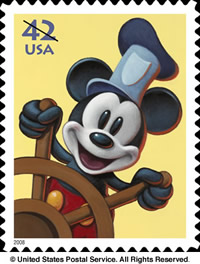
"One of the most disastrous cultural influences ever to hit America was Walt Disney's Mickey Mouse, that idiot optimist who each week marched forth in Technicolor against a battalion of cats, invariably humiliating them with one clever trick after another.
I suppose the damage done to the American psyche by this foolish mouse will not be specified for another 50 years, but even now I place much of the blame for Vietnam on the bland attitudes sponsored by our cartoons."
James Michener
Sunday, July 19, 2009
Quick Kells
The stills, two or three that I had seen, were unappealing. Despite internet enthusiasm, I had no expectations for "The Secret of Kells."

No expectations is for the best.
Turns out the character design works well for animation, and the big blocky ugly hands are unobtrusive.
above: an animator's reel
A few scattered thoughts:
The animation itself is workmanlike, without much flourish. The design overpowers the picture.
The film owes a great debt Richard Williams -mostly in design. "The Thief and the Cobbler" predicts the ornate quality mixed with the tight retro-style line.
The crowd layout is particularly strong. Crowds of several monks move with a witty stylization.
It's a kids film, but contains very few throwaway gags we've seen in American children's films.
No expectations is for the best.
Turns out the character design works well for animation, and the big blocky ugly hands are unobtrusive.
above: an animator's reel
A few scattered thoughts:
The animation itself is workmanlike, without much flourish. The design overpowers the picture.
The film owes a great debt Richard Williams -mostly in design. "The Thief and the Cobbler" predicts the ornate quality mixed with the tight retro-style line.
The crowd layout is particularly strong. Crowds of several monks move with a witty stylization.
It's a kids film, but contains very few throwaway gags we've seen in American children's films.
Saturday, July 18, 2009
Blueberry Scoop
We did some motion graphics for the documentary "The Mighty Humble Blueberry" which is now available on DVD.

Did you know blueberries weren't domesticated until 1911?
Were you aware that domestication happened in the Garden State itself?
Here's the trailer:
Signe Baumane also did some title card illustrations for the film making it even more cooler.
Friday, July 17, 2009
Old Armor
More R. O. Blechman rareness.
"The Emperor's New Armor" was made for Aspen 1969 Design Conference. Animation was by Al Kouzel.

I got the film on eBay several years ago. It's a Kodachrome stock and a little pink. At one time is was property of Pyramid Films, the legendary distributor.
This one is rare. Later, we'll post an even rarer Blechman short "The Emperor Visits".

The story is an anti-military parable. Some shysters convince the emperor he needs armor.
They sell him a spikey plate mail which destroys everything in its vicinity.
 Naturally, the only remedy is to buy armor for everything else. The dining room furniture, the wife, the cat, the mice.
These are a couple shots off of the wall. Still working out the kinks on the projector.


His son returns, not wearing any armor. He runs to his father and is quickly crushed to death by its weight.
 The ironic moral: In a world without armor, nothing is safe.
Subscribe to:
Posts (Atom)