Often it's best not to think about animation. I know, I know, Dick Williams says think about all the time and do it all the time, but solutions regularly come when the mind is set to other things.
Friday, at a seminar on Liberal Arts Education in the Twenty-First Century, I figured out an animation problem (it should be a sneak, not a walk). It also gave me a lot to think about regarding animation education.
Standardized education in America focuses on survey knowledge. A lot of facts, not necessarily comprehension of their relationship to one another. Coverage.
Even in animation education, already a specialized field, a common -and successful -pedagogy is for students to become miniature production entities. In our field this may not be a net negative as long as connections to the broader scheme are enforced.
More harmful, in animation studies, the teaching of facts which imply there are "right" and "wrong" answers. Exercises from Preston Blair or Tony White provide these "correct" answers but at the expense of exploration and the intense confrontation with ideas that can lead not just to problem solving- but to a fuller understanding of the medium.
If a Liberal Arts education develops ways for students to create strategies of intellectual inquiry (or survival in a chaotic universe), a student should complete an animation education with the ability to animate, sure, but more importantly the ability to use animation as a means of solving storytelling problems.
A nice little movie for a Monday morning. It's my favorite piece to have been created by one of my students even post graduation.
"A Circus Story" was made by Yong Choe and Julia Vallera as their thesis project a few years back. It was made during the term after they took my two semester Production class.
As you can see, I really hammered in the Hubley and they "got" it. Sure, there are the superficial similarities to Windy Day or Cockaboody -the flat layering of translucencies, the real audio, the camera work, even the design style.
Beyond these external similarities is an altogether different vitality. It's the same thing that places Hubley's films beyond the work of all the rest. It's soul. It's the mixture of joy and melancholy. It's the description of the human experience as the cumulation of love, longing and experience.
Yesterday I learned of the passing of my favorite college teacher, Jean Le Courbeiller. He was, ostensibly, a science and mathematics teacher at a college which didn't even have a science section in the library (one could concentrate in "Mind, Nature and Values" if they wanted to try bucking the system).
I still recount his story of growing up on Isle de la Cite in the middle of the Seine.
One day, when he 8 or 9, he bicycled in the rain to his girlfriend's apartment. There was often a man standing in lobby and today the man asked him about the rain. "It's raining, yes." "Oh yes, it's raining." "It's raining hard, isn't it?" "Very." The conversation was interrupted by the girl's mother who came yelling at him for coming out in such foul weather.
The man was asking about the rain because he was blind. A few years later young Jean learned that the man was not just blind, but his young sweetheart's neighbor was James Joyce.
You can master language, and still lose something we all take for granted.
In one of his classes he remarked that Isaac Newton was the last man on earth who could possibly know all there was to know. Newton, being the smartest man of his age, might well have known all the science and math and history and literature that [Western] Civilization contained at that moment.
Even in a field as limited as animation, I'm learning new things all the time. Things other people already know.
I didn't know, for instance, that the Korean Academy of Film Arts produced a feature length collaborative project as a senior thesis. Actually, I may have heard that and forgot -which goes to another point from Jean: learning is re-learning.
It's questionable to put students to work on such an endeavor. The school is there to further the progress of the students, not the other way around. There are benefits to the students, sure, but that doesn't ameliorate the lapse of ethics on the part of the school.
The Korean Cultural Society presented a screening of The Story of Mr. Sorrylast night at the Tribeca Film Center. This collaborative graduation effort kicks off a series of four free screenings of animated Korean features.
The film itself is interesting and hangs together very well for a work with five credited directors. We're not privy to the actual hierarchy of artists, so I suspect there was one lead voice with vocal contributions from the others.
The animation isn't particularly special. It's primarily the sophisticated cutouts we've become accustomed to seeing.
The design is sometimes nice.
The narrative, based on novel, is just slightly off in that Korean Cinema way to keep it from being completely fulfilling. It's as though they've digested American film, try to recreate it, but come up with something strangely similar but vastly different.
In his course "Four Ways of Doing Astronomy", I learned from Jean le Corbeiller that the Sumerians looked to the horizon for their astronomy. All their science, all their mathematics -like the 360 degrees in a circle -derived from calculating the relationship of the stars to the visible edge of the earth.
These days our astronomy is almost completely mathematical. There's little observation with the human eye. Data is collected through non-ocular telescopes, decoded and translated into information we can understand.
Neither method is better than the other. They just respond to the differing needs of the cultures that support them.
The final year of animation program should do (at least) two things.
First, it should continue to develop a student's technical skills.
Second, it should be a kind of creative crucible -a production which incorporates the previous years of study and pushes concepts against practicality.
It's not unreasonable to expect a 2:00 film to be produced. The bulk of a student's credit hours should be dedicated to producing the thesis film. 6 class hours a week. Here a student will learn professional production practices.
Continuing to develop animation skills, we'd use Richard Williams' "Animator's Survival Kit" as the final year workbook. By this point a student should have a basic grasp on animation mechanics, making the advanced studies in this book useful.
This is also the time to start developing as filmmakers. There are two general film resources which are invaluable.
Steve Katz' "Shot by Shot" and John Sayles' "Thinking in Pictures".
The third year curriculum should be the most difficult for an animation student.
First, anyone who uses the word "animations" will automatically fail for the year.
Basic concepts of draughtsmanship and ways of thinking about animation should be fostered in the first two years -along with a rigorous dose of animation and film history. Year three is when those ideas begin to find their ways into practice.
We would also have two current concept paths throughout the year: 1) story form, and 2) animation technique.
Thrown into the mix will be software courses: both 2d and 3d software. Though, I have to admit, I don't have a good plan on how to approach 3d software. In my opinion that would be a 5 year program with software being introduced in year 3, expanded on in year 4, and "perfected" through production in year 5.
Start with story. First and foremost:
Brecht on Theatre in conjunction with
Aristotle's "Poetics".
Storytelling is largely instinctual. I think it's a bad idea for young filmmakers to first study books which expound on form and formula -even good books ("Save the Cat", being a prime example).
These two texts -"Poetics" and "Brecht on Theater" present ways of thinking about storytelling. They're not "How To..." manuals, they're texts which help an artist understand their instincts. These writers provide a vocabulary for discussing and understanding what makes a narrative work.
On a practical side, I hate to do it, but I've got to "double dip" authors with Nancy Beiman's "Prepare to Board" (I also like her other book for 2nd year development).
This leans a little step-by-step for my pedagogical tastes, but it's well written and gives useful legitimate information. Most storyboard books don't.
I'd love to see a volume that just collected boards from various sources -Warners, Disney, Plympton, commercials, Dora the Explorer, independent shorts -with little commentary. That's the best way to see what works.
For animation lessons, I'd use two workbooks. It's important to remind students that there is more than one right answer when it comes to animating. That's a tricky concept -since often a character will dictate that there is only one "right" way to animate, but that "right way" can't be universally applied.
The best of the animation workbooks is Halas and Whittaker's "Timings for Animation".
Unfortunately, the revised edition of this book is a step down from the original incarnation but it's all that's in print.
That would balance with Tony White's "Animator's Workbook".
Thus concludes the core reading for year three of my hypothetical animation program. I'm sure I'd load in other supporting, dissenting and seemingly irrelevant texts too.
There are a million lessons to be had here, but to number a few:
1) fearlessness: Experiment, mess up, do things even if you don't know whether it'll work (HINT: if you've thought about long enough, you've probably worked out how to get it done)
2) time: Touching film, cutting it up, looking at the little pictures -you see the meaning of a frame. It's a sledgehammer way of showing the value of a single image as well as its worthlessness.
3) community: You, student are laboring by the dim light of your Cintiq, there are others out there like you. Talk to them, share with them. Your colleagues are your greatest resources. They're more important than any films you can produce, more valuable than any awards.
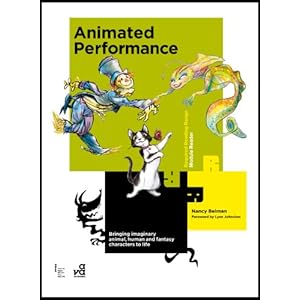
We've got to get to the flour sack sometime, and Nancy Beiman's "Animated Performance" is the best introduction.
She's still concerned with how you think about/approach animating but has exercises to put them into practice.
After several months of preparation, artists should be ready to animate.
There's no better reference for motion than Muybridge.
The best artists make a continual study of history, for animators the history of their field is especially important. Past animators and films form a lexicon which can communicate ideas elegantly and accurately to those who understand the language.
There are multiple sides to every story. Most history books (even Barrier's) tend be told from the studios' point of view.
Tom Sito's "Drawing the Line" looks at animation history from another perspective. Its full of interesting stories -but the fact that is shows the business of animation from a different angle is more than enough to make it pedagogically important.
There are many people of my generation, I bet, who wanted to be archaeologists and college professors. Indiana Jones. Lecturing one day, battling Nazis for ancient mysteries the next yet still finding time to get the girl and crack one liners.
For many of us, that dream rests somewhere in our unconscious -manifesting as occasional flights of fancy.
Sometimes I daydream that I've got a well-salaried, tenured position with an oak paneled office at an Ivy League style animation university. While my methods would change from year to year (some classes get a cheerleader, others a drill sergeant), I think my course material would be fairly consistent.
Here's the first year reading list.
Miyazaki, Hayao: Starting Point. This is possibly the best book around animation. Plus kids these love "Totoro" and all that stuff. A text like this creates a bridge from the familiar -most students today are closer to "Porco Rosso" than they are to "Pinocchio" -to a new and brilliant way of thinking.
In some ways, its too easy to start with this book -if a first year student understands the lessons within, they may well grow into an animator one day.
Again, too easy. Bendazzi's book may have some flaws (it's very Euro-centric) but it remains far and away the most comprehensive survey of animation history. There's not too much analysis and the illustrations and synopses make a reader want to seek out the films.
While just about every student knows "Princess Mononoke", this is a book which will introduce them to one hundred years worth of films they might love even more had they only known about them.
This is a book about effects animation! Am I crazy? Where's the sack of flour? Where's the bouncing ball? Where are the walk cycles?!?!?!?!?
Joseph Gilland's "Elemental Magic" lets you know how think about animating. He gives you techniques for seeing and translating what you see into what you commit to film.
As energizing and exciting as it is seeing your drawings move, throwing a novice in front of a lightbox with a copy of Preston Blair will give them the idea that this is way animation should be done. That's 100% wrong. Animation should be done by thinking about it for a long time before you even pick up a pencil.
O. K., O. K., sometimes you have to think by drawing.
That's why they'd be in life drawing for a few hours every day and have Thomas Eakins' drawing manual on their reading list.
David Levy wrote earlier this week about a new trend in broadcast animation away from the hard-edged "CalArts" style towards a more idiosyncratic "RISD" style.
There's something to this shift away from the geometry seen in kids programming. In part, its production artists becoming more adept at the tools producers are providing (Flash) and squeezing more juice from the lemon. It's also part of the cultural pendulum that design swings through -look at the classic "50s" style exemplified by UPA. That was overtaken by the ornate graphics of the 60s Pushpin school which, in turn, lead to the softshell 70s designs we know best from The Electric Company and Sesame Street.
In my mind, a lot the product he writes about is warmed over "Krause". Fran and Will have created a series of distinct, intelligent films which have trickled down certain sensibilities we're seeing broadcast today. It's no coincidence that their pilots flopped with arrows in the back, while similar shows have gotten picked up by the same execs a few cycles later.
In any event, the purpose of this post is dual 1) to talk about how brilliant Fran Krause is, 2) to brag about working with him on The Buddha for a little segment.
This is strength of the education I've seen from RISD. While producing students who have distinct styles, they also equip (or at least try to) them with the tools they need to be successful professionals in a diverse field.
Honing quirky storytelling skills is important for a student, but more important is learning how to be an animator. That's someone who can rattle out some neat personal films as well as make a string sing.
It's important to remember that even in animation, there is a Middle Way.
We'd have hundreds of perspectives on the process. Maybe a supercomputer could process them all and come up with the elusive answer to how it's done. I remember reading a similar thing was done to films resulting in the determination that Eastwood's "Unforgiven" was the best screenplay written.
Unlike other books by animators (Richard Williams, Tony White, Eric Goldberg, Halas & Whittaker, Preston Blair) this one isn't overloaded with drawing by drawing exercises that show exactly how to draw a scene.
The book explains why before it shows you how. Along with Joseph Gilland's "Elemental Magic" this represents a pedagogic shift in animation instruction -a shift I find welcome. Interesting that both authors were staffers at Disney in the late 1990s. These two books make good companions.
"Animated Performance" doesn't sidetrack itself with too much on techniques outside the author's strength. She's a pencil animator, the book is about pencil animation with passing nods to other media. That's a great strength. Books that try to cover too much ground wind up apologizing for the conflation and doing justice to none.
In the tradition of Thomas & Johnson, Beiman relies on personal connections to films to illustrate points. Like them, she acknowledges the ideas of other artists. Interviews and anecdotes with other artists are woven throughout the book and there's no restraint in letting these artists speak for themselves.
It's top notch primer. In fact, I would recommend first time animation students begin with this text (and Miyazaki's "Starting Point") before proceeding to Tony White or Halas & Whittaker and then Williams. Right there you'd have a solid three year course of study.
The Illustration Department of Parsons School of Design has its Senior Show up at The Art Director's Club.
A few of my former students have work up.
Noella Borie is the only student with film in the show.
There's a range of work. Some students are naturally gifted -excellent draughting, strong ideas, good design.
Some aren't so talented. And here is where the Illustration Department at Parsons makes the difference -it's clear that even the less skilled students have been guided to make the best the use of their strengths in their work.
More impressive than the good work on display is the underlying strength of faculty.
Unfortunately, the animation program at the school can't make the same boasts.
Noella's film, for instance, works on the strength of her efforts and personal vision. It's failures are primarily in production and animation fundamentals which should be established by the school.
(Note: I sometimes teach adjunct in the dwindling undergraduate program at Parsons)
The digital design program at Parsons, especially the MFA, which focuses on new technologies produces a lot of extraordinary work. The possibilities are there, the institution needs to get behind its film animation program for it to excel.
There are issues in animation education. Many issues.
Most of these parallel problems facing higher education in general and arts education in particular. Primary is the transformation of the University to a "service institute" -a place where the student is a customer and the customer is always right.
Some students excel in an open environment. In animation programs, these are the artists who already have a basic drawing/painting skill set who are motivated to learn beyond the classroom and their peers and who have things they want to say.
Last night Pratt Institute had its Senior Show at Anthology Film Archives.
Several years ago the program was vibrant. It produced several students with accomplished character animation skills as well as a few interesting experimenters. It seems the traditional animation has shrunk. It's even hard to find on their website, giving the appearance of an administrative phasing out in favor of the more lucrative digital animation path.
The evening's program consisted of ten or so students -each of whom has something commendable in their work.
Most East Coast animation schools are geared towards fostering individualist filmmakers. Keep in mind that most 20 year olds have little to say. This leaves the viewer grasping at moments, holding on to bits of strength -a nice turn of animation, strong layout, smart design or color choices, interesting effects.
While most films offered moments, one student, Kelsey Stark presented a thesis film which was remarkable by itself. I didn't catch the title -Ghost Progression, maybe. Something with ghosts, anyway.
It's almost rises to level of JJ Villard's "Son of Satan" for great student film.
The thesis film isn't online, but she has another very good film:
Everyone knows, if someone from Kalamazoo asks you for something, you do it right away.
Lisa Santoro was making a film for school on color and wanted to interview someone at the studio.
The result is a polished, professional documentary -the kind you might see on a rainy weekend afternoon on public television.
I sound like an idiot -but sometimes don't sound completely drooling thanks to her kind editing.
The film features interviews with Leslie Harrington - a color strategist, Carl Minchew -the director of color technology at Benjamin Moore paints, Patricia Lynn Duffy -a communications expert and author and noted synesthete, Dr. David Krumholtz -an ophthalmologist with color blindness.
An interesting facet of this film is the level of professionalism achieved by one woman working on a student project. A contributing point of interest is the genre (or more properly -method of inquiry).
The documentary form is as diverse as the technique of animation. Today we are in the middle of a documentary explosion. Films of vastly divergent approaches, perspectives, subject matters and styles are all finding a degree of success. Compare that to the films using animation as a method of inquiry, and it's easy to see the paucity of fresh ideas coming from animation programs in The United States and Canada.
Leave it to a proprietary college like SVA to ask the big questions in their advertisements.
For much of the early 21st Century New York City subways were covered with their "Art Is..." campaign, a series of posters executed by their luminous faculty.
I don't understand the mysticism imparted on the word "art".
Maybe I do. It's assumed that if something is "art" is not as "good" as something else that is "art" -that it's a qualitative judgment, not a quantitative definition.
Mystifying art gives critics something to talk about and colleges an excuse for failure.
Working in advertising, the most self-awarding of all industries, you often hear people relate commercials to art. Commercials are never art. They are (often) well conceived, beautifully executed, imaginative -all those things we ascribe to museum pieces. So what distinguishes them?
We can start with the mystic. Art illuminates the human condition/universe channeled through the voice of the creator. Even if its anonymous or collective (like film, symphony, etc.) art has a distinct voice.
Now lets move to the physical. Art is created with no practical purpose in mind.
A commercial is trying to sell you something. Propaganda is trying to convince you of an agenda.
To me it's a simple definition, and an easy distinction.
Masks, ceremonial drums, tuxedo jackets -these may be beautiful and profound but they are altogether something different from art. We experience them differently, they have a different purpose. Great, possibly. Art, no.
One of the many unappreciated poeticisms of the syllabus -we end with a class on title design (which includes a bit on end credits).
This year I pulled up the opening titles to "The Partridge Family" after screening the titles to "Blacula". Both were designed by Sandy Dvore.
TV titles are usually pretty stingy budgets. There are two points of interest to this piece. Two things that make it good design.
First is obvious. The economy. The animation is simple, clear and based on repeat action with color variation.
The second is narrative and a little subtle. All of the "family" are introduced in the same way -through the little birds: the manager, Ruben, is introduced in a different manner. This also allows for the transition to the live action bus at the end. A story is being told through the gesture of the graphics.
Favorite former student (and until some of you other whippersnappers step up it's gonna stay that way!) Hanne Berkaak just finished up this lovely little film.
It's for an educational website. The imagery and production value are full of charm.
Technique-wise -it mixes stop motion, live action and special effects but retains a homemade warmth as well as a professional sheen.
Tuesday's class focused on genre. Since the thrust of the class is on narrative concepts, the categorization of stories by similar traits or tropes particularly illuminating (I hope -it is for me anyway).
Let the Right One In, for instance, has more in common with Marty than it does with The Lost Boys. That similarity brings out a deeper meaning to both films.
In the past, I would bring up animation. "Animation" must be a genre, right. Like Westerns it gets its own tiny section in the video store. That's fair enough, as much as "Cinemascope", "3D", or "Odorama" can also be group together.
And that grouping hints at what animation "is" what distinguishes animation and sets it apart.
Tissa David tells of when she came to New York in 1957 (I've forgotten the exact year, it could have been '58, not earlier, not later). She had seen the animated sections of The Four Poster while living in Paris (after escaping Budapest on foot shortly before the Uprising). From these clips she decided that she would go to New York to animate for UPA.
Two issues with that plan: she didn't speak English, and women were not hired as animators in 1957.
She shows up at the 666 Fifth Avenue studio with her portfolio, and they're ready to usher her out when someone says "Grim Natwick just fired another kid, so he needs an assistant." They are introduced, and as Tissa said, Grim must have taken pity on her and said that he could speak a little German, and she could speak a little German so they could communicate that way (although neither knew more than 100 words) he'd give a shot on one condition.
Grim said she had to answer one question: "What is animation?". Stumbling in pidgeon English, Tissa replied, "Animation is, is animation."
He took a step back, laughed, and said "I've been asking people that question for the past 30 years and that's the best answer I've gotten yet".
An indisputably true answer, but a little vague for definition purpose. The "Animation" section is like a "Silent Film" section. The pictures are grouped by technical similarities.
Animation, like 3D or Cinemascope, is a process. That's what defines it -not happy-go-lucky mice or singing princesses or wacky buddy journeys. This definition comes even clearer when the other section of cartoons films in the video store is discovered -"Anime". These are films which, for the most part, share stylistic and narrative tendencies. Grouping these together, and in their subsets, gives a deeper understanding of the individual films.
One session of my course at Parsons is dedicated to Brecht's "Notes on the Opera Mahagonny".
I wonder how the students take it when I say things like "everybody back then was a Commie." Do they know what that means? What that would have meant culturally twenty years ago? Eighty years ago?
Brecht's thinking, which we'll sum up as "verfremdungseffekt" in order to incorporate the three major parts of his philosophy (story structure, production/direction, performance) has particular resonance for animators.
I'll write more exhaustively about this in future.
For now, a brief bit: one student asked what "man as changeable" meant. I explained with two example from Brecht's work.
The clearer is the scene from "Life of Galileo" (with Charles Laughton as collaborator) in which Barberini, originally Galileo's defender, becomes convinced that he must be arrested. Throughout the scene Barberini is being outfitted as Pope, when the final piece of costume is placed his resolution is firm.
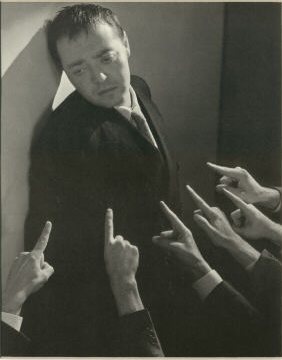
The other scene is from "Mann ist Mann". Gaily Gay gives his own eulogy, convinced that the he is someone else. This was a part originally played by Peter Lorre.
"You all know Peter Lorre, right?" Of course not.
Coincidentally, this class was on the same day as John Canemaker's Chuck Jones documentary kicked off an evening of classic animation on TCM.
Unfortunately, the Jones' directed "Hair-Raising Hare" was not part of the bill.
looking for a video clip from "Hare-Raising Hare" I found this:
Peter Lorre on "What's My Line?" pimping "Scent of Mystery" in Odorama.
Fascists drove him from his homeland, Hollywood drove him to the needle.
Here's a poem Brecht wrote after Lorre and his struggle to make it in Hollywood:
"The Swamp"
I saw many friends
And the friend I loved most
Among them helplessly sunk
Into the swamp.
I pass by daily.
And a drowning was not over in a single morning.
This made it more terrible.
And the memory of our long talks about the swamp
Which already held so many powerless.
Now I watched him leaning back
Covered with leeches in the shimmering,
softly moving slime
Upon the sinking face
The ghastly blissful smile.
"Scent of Mystery" also has a mark in animation history.
The opening short was also in Odorama. "Old Whiff", directed by John Hubley. Ed Smith told me he did some animation on it, according to Michael Sporn, Tissa David said she and Grim Natwick worked on it as well. This may have been one Tissa's first jobs at Hubley, production would have been in 1959/60. They had just finished "Terror Faces Magoo" at UPA. Tissa didn't animate for Hubley until later in the 60s (that's another anecdote) and Natwick isn't credited on any of his independent films (to my knowledge). They did do commercials with Hubley all during the 60s, though. And obviously, John and Grim had a long working relationship prior.
This film is no longer extant.A few years back I emailed F. Gwynplaine MacIntyre who posted an online review. "Where did you see it?" I asked.
He's an extraordinarily friendly chap with mighty, mighty facial hair. (order his book) He had seen it in the private screening room of (Lord) Lew Grade. I believe the British impresario had purchased at least part of the Todd A-O company (inventors of Odorama), although I can't find anything online to confirm that.
In any event, that's the last known location of this Holy Grail. Lew Grade died in 1998. His nephew, Michael Grade, was his primary heir. Presumably, and hopefully, Hubley's film and scratch and sniff cards are safely locked in a secret vault deep below Buckingham Palace.
I did make a half-hearted effort to contact Sir Grade but forgot about it after two or three days.
Last week's ASIFA screenings ended with Don Hertzfeldt's I Am So Proud of You. I won't go into that film here, other than to say it's best quality is the emotional realness of the mom giving the son a daily note in his lunch "I am so proud of you." That emotional realism is traded for gags, but it touches a beautiful moment. That's what makes the work especially disappointing -it's not as clever as it thinks it is (further evidenced by its strong need for an editor).
The best thing I could say about it -and this is too kind -imagine if Joe Frank wrote an episode of "Family Guy".
Moments like these litter the sidewalks. All too rare in animation.
The design is part Pablo Ferro, part Stefan Sagmeister. In the entrance of the building at 2 W. 13th Street, this is just the sort of thing that art schools (and animation studios) should have.
Yesterday I was so concerned with beating the Friday the 13th rush, I neglected to note the 200th birthday of the 16th President.
You may have noticed, I've taken to writing a daily post. This was inspired by Suzan-Lori Parks' 365 Days/365 Plays.
One of these plays was a comic strip by R. Sikoryak.
Suzan-Lori was my teacher in college. I'm sure she'd be surprised to hear that her class has had so much influence on my thinking.
She confessed that she always worked on several things at once, so when she gets stuck or bored there's another project to distract her. I've found this to be a most rewarding method of work.
She also has a peculiar method of "mapping" ideas with little pictograms.
Most importantly, she insisted we write exactly as our characters spoke -not to rely on the "proper" language nor conventional slang. It's a method which forces the writer into acting and through acting the writer better understands human.
Treasure!
Some notes from class, and the magnum opus it produced; "One Sign of Nationalism, A Potted Plant".
Here's an excerpt:
I.
Girl in Ribbon: One sign of nationalism, a potted plant.
(The World is divided)
Girl in Hat: Dear Kitty, today I found not just one but two pennies. And right side up at that! I feel my luck is about to change.
Man of his Times: Little girl, little girl, why are you on the floor? Didn't you hear me? Didn't you hear me? Why are you on the floor?
Girl in Hat: Hiding.
Man of his Times: Hiding? Hiding? What are you doing, little girl? Little girl, what are you doing?
The text is a little dense for art students, so this year the plan was to cut it with Vogler's Writer's Journey. Contemporary contextualization.
Poetics lays out about 10 or 15 concepts on storytelling. Plenty more, since concepts have components.
Aristotle's emphasis on "imitation" in art have particular resonance to animators.
"Tragedy is an imitation, not of men, but of an action of life, and life consists in action, and its end is a mode of action, not a quality."
A problem with the modern actor from the "Method" school is they insist on "becoming" the part. This presentation removes performance from it's ritualistic/religious roots and transforms the performing arts from an arena for the audience's self-discovery into a cult of personality.
An animator always imitates their subject. Ken Harris didn't pretend to be Bugs Bunny -he showed what a character like Bugs Bunny might do.