No figure today in animation demands a documentary treatment more than Bill Plympton.
It could be argued that he's the most the important single figure in the past 25 years (moreso than Lassiter, Keane or MacFarlane) -the previous 25 belonging to Bakshi, the 25 prior Hubley, Walt Disney before him all the way back to Winsor McCay.
Adventures in Plymptoons had it's sneak premiere at the Museum of Moving Image yesterday before it's grand unveiling in Annecy next week. There's plenty of material within the film to support the idea that the Plympton story needs to be told.
Beyond the technical issues -like it or not, fuzzy mattes and noisy audio which may be acceptable in an issue documentary become an issue in documentary about film -the serious flaw was hinted in director Alexia Anastasio's introduction.
She recounted a funny story about trying to "get" Kanye West for the film. His appearance was foiled after his infamous Grammy Awards episode sent him to a self-imposed media exile. Sure the pop star worked with the animator on a music video, but really, who cares? What sort of insight could he offer on the man or the work?
There lies the fatal flaw in Adventures in Plymptoons, the viewer is treated to an constant stream of interviewees who seem chosen for some sort of celebrity appeal with few offering more than a line or two of hagiography. Most stories are enjoyable -"Weird" Al Yankovic, for instance, is a personable and funny as you'd expect- but the cumulative effect is a white noise of talking heads. Voices who might have otherwise broadened the scope of the film -Signe Baumane who senses a touch of misogyny in one particular scene, Ron Diamond on Bill's relationship to the commercial world -are given equal or less time than a voice actor who had maybe three hours interaction with the subject.
The talking head format fights the contrapuntal "quirky" approach. Some of these segments are surprisingly rewarding -Bill Plympton serenading Troma's Lloyd Kaufman with "The Nose Hair Song" is one particular highlight.
Casual fans will likely enjoy some of the anecdotes (many are also recounting the excellent Independently Animated). The uninitiated will see some great work though they might not fully understand why Bill Plympton is such a big deal. Those looking for something more might be a little disappointed.
Showing posts with label criticism. Show all posts
Sunday, May 29, 2011
Sunday, December 5, 2010
Back From Mars
Some of the acting is pretty bad. A lot of the dialogue flat and wooden. Sometimes the design and graphics border on grotesque. But sometimes the design and graphics are sublimely beautiful and despite the sometimes weak moments of copy the script is structurally solid and incorporates enough not-too-bizarre outlandishness (like a swaggering Kinky Friedman as President) buoy any occasional banal banter. The music is also first rate and perfectly balanced with the picture.
Geoff Marslett's "Mars" is an unconventional, rewarding and thoroughly likable film.
It will be playing at the ReRun Theater in DUMBO until Thursday. The room itself is comparable to the film. You step and think -oh, this is just some shitty room in the back of a bar -but it transforms into a warm, friendly place (a bit of Brecht with a full bar in the theater). The projection is good -1080p and flawless screen -the seating comfortable, settling in quickly as a nice place.
Technique-wise it's a mix of animation with processed video. The performers are chroma keyed and processed using a software the director wrote, the environments are animated and the mouths and eyes are essentially rotoscoped.
The comparisons to Bob Sabiston's work with Richard Linklatter (and especially Linklatter's "A Scanner Darkly") are natural. Artist developed software applied to feature in Austin. Simple headline.
There's a deeper connection, too. The Linklatter films a mature expressions of an alternative possibility for single frame filmmaking. They're grand scale experiments in technique.
Where those films sometimes fall short is one of the great problems with animation -empathy. Animation has a hard time connecting on a character to character level. The technique is so effective with children, in part, because children have a greater capacity to personally connect with inanimate (though animated) objects. The more live experience we get, the more we are compelled to find personal connection on screen.
"Waking Life" concertedly pushes the viewer from this personal connection through it's episodic, non-linear narrative. This intentional conceit -and the general novelty of the visuals -carried the picture without relying on the audience connecting with any of the faces on screen.
Lack of empathy was a real problem in "A Scanner Darkly". I still feel this is amongst the most important animated films since "Snow White", but it still is saddled with that frame-by-frame verfremdungseffekt inherent in the technique.
The process in "Mars" thins the barrier between human and cartoon -so those layers of paint which cover the faces in "A Scanner Darkly" are more like rose colored glasses.
Like "A Scanner Darkly" -even moreso, and most importantly for filmmakers everywhere -this technique was the most efficient, cost effective way of telling this story in a compelling fashion. By designing this world, the spaceships, the Martian landscapes, the robots and the real world all blended seamless with the characters. In order to present that level of production with standard live action or full animation techniques would have required 100 times the production budget and maybe still fallen short of the results.
Why make a film in this manner? It seems like there was no better to tell the story.
The quibbles I mentioned are minor nitpicks, most likely the results of production demands. They're easily overlooked in such an enjoyable piece of work.
One thing does bother, though. It's a love story, but we don't see the action of falling in love. One of the reasons I find Brent Green's "Gravity Was Everywhere Back Then" so touching is that it shows the moments that made the two characters connect and the central theme of the film flowed from the results of those moments. Here we're shown episodes of starbound lovers gradually moving closer together but never that time in between when we would see why they bonded. Those episodes are nicely handled and compelling in themselves, that's why it would have been interesting to have been party to the mechanism and not simply the results.
Love stories all come back to "Romeo and Juliet". Romeo and Juliet's families were killing one another, that's what was keeping them apart. Pretty serious. Too often we see romances on film where there are no real barriers to the couple getting together. There were some barriers to be overcome in this relationship and I think the film would have benefited from exploring those a bit more.
Like Bill Plympton's features, Nina Paley's "Sita Sings the Blues", even Paul Fierlinger's long form work the mere existence of "Mars" is a feat for the process of animation. Like those artists' work, this may not have the seemingly universal appeal of "Toy Story 3" or "Tangled" but it has the personal touch of an individual thinker. It has something to tell us, anyone who cares about film, animation, art or just being human should make every effort to drop the $5 and find out what.
Sunday, August 29, 2010
How Does He Do It?
Famous Original Patrick Smith (not to be confused with Original Famous Patrick "Guys Coming Out of Guys Coming out of Other Guys" Smith) has just added a new piece to his site VectorPark.com.
I'm not embarrassed to say I don't fully understand VectorPark- not in the sense a film or painting or even a video game can be understood.
Using a Flash interface, VectorPark is mildly interactive like a game, it's somewhat cinematic and it's more design pretty than painting profound. It all comes together as something inexplicable -Art.
In the new story, "Thomas: Seasons" the user follows and controls a unicycling egg through landscapes. Each turn off course reveals something fantastic.
Monday, August 2, 2010
Animating Reality
A second DVD review in the span one week. You'd think I sit around all day watching cartoons.
This disk came in a little over a month ago and it's taken me this long to finish it. Animating Reality: A Collection of Short Documentaries (distributed here) clocks in just under three hour with 13 films. Most are fairly serious, so it's not really a compilation that lends itself to a single screening.
Not a single film here is both animated and documentary. The animation may by-and-large be non-fiction but some are closer to Maya Deren's Meshes of the Afternoon in form and tone. The canvas of non-fiction can hardly be stretched to cover that film, but won't argue against anyone who would assert that it's the poetic meeting place of fact and fantasy.
The most touching piece isn't animated. The short documentary Birdlings Two is a dialog between the filmmaker Davino Pardo and her father Rene. The filmmaker is surprised to find that her father, a businessman, made a film with Norman McLaren and the NFB twenty five years earlier. Their conversation is conducted over faded photos and super 8 footage of the young man diving into a swimming pool while wearing a suit. It's a lovely little film.
Like many of the DVD's pieces, Birdlings Two is a student film. I find it encouraging that many young filmmakers are making work that is unconstrained by technique and cookie cutter narrative. If only every graduating animator with a Kung Fu Granny thesis film put their efforts into something more personal like these films, something beyond an "audition" for a big studio -if only...
Also interesting is Wiener Wuast by Maya Yonesho. This is a simple concept well executed. Index cards with abstract watercolor animation held in front of a camera in Vienna. Cute and well done.
This disk makes an interesting companion to the Annecy collection. Both have distinct non-American slants, while the Annecy disks cover the heavy hitters of the international animation world, Animating Reality contains work by artists largely unknown in the animation community: one film screened in Annecy, One at Anima Mundi and Holland and none in Hiroshima or Ottawa.
Friday, July 30, 2010
Vive L'animation!
I may have been to me, but I've never been to Paris and, unfortunately not Annecy.
A top-tier animation festival (and should be considered along with Ottawa and a few others a top tier film festival, in general), Annecy celebrated it's 50th Anniversary this year. In commemoration, they've released a 5 DVD set containing 40 films highlighting the half century of international animation.
The DVDs are Region 0, PAL. Americans might not be able to watch them on their BluRay decks but any computer should have no problem. BUY HERE!
And, being French, the booklet and menus are in French. The overwhelming majority of the films are non-verbal, some (like "Frank Film") are in English with French subtitles, others (like "Bob's Birthday") are strictly en français and we just have to lump it.
Many of these films aren't easily screened in any language: Robert Mitchell and Dale Case's "Further Adventures of Uncle Sam" (a iconic slice of 1970s zeitgeist), Alison de Vere's "Mr. Pascal", Jean-François Laguionie "La Demoiselle et le Violoncelliste", and many others.
Also included are several popular films from this century -Chris Landreth's "Ryan", Jeremy Clapin's "Skhizein" and Michael Dudok de Wit's elegant "Father and Daughter".
These are 40 films which represent the best of international animation for the last 50 years, even with the exclusion of many American greats, it's a showing which make you proud to work in the same field as these greats.
(On a practical note, this ships from France. I ordered on a Monday and received the package Thursday, standard delivery. No problems.)
Wednesday, July 14, 2010
Modern Dance
In professional football, I can point out the successful strategies and executions that bring a team victory -not just in the game, but on a play by play basis.
A good percentage of American males can do the same thing.
This skill can be applied to all sorts of productions: baseball, animation, painting. Once you have a grasp of the vernacular, every act of creation can be dissected and understood this way.
Dance has always seemed alien to me. I tune out the ballets in Wagner and get lost watching any steps short of the Nicholas Brothers.
Art Spiegelman should be admired for his energetic pushing of limits, for his tenacity in conquering far off forms like opera and dance.
His "Hapless Hooligan in 'Still Moving'" is one of four pieces being performed by Pilobolus at the Joyce Theater through August 7. It's an odd vaudeville, largely entertaining and the motion graphics are cute but wear thin. They compare, unfavorably, to Kentridge's "The Nose" recently mounted at The Metropolitan Opera but still hold a degree of charm.
The piece plays with antique comic strip archetypes. You've got the Blondie style waif, the cad beau out of Fontaine Fox. Spiegelman has spent much of his career trying to convince us that comics are something other what the English speaking world wants them to be. He transports the newsprint tropes -Krazy Kat brick and all -to the dance stage.
The comic has a long history going to the stage. Buster Brown at the turn into the 20th Century, L'il Abner at the half way mark, and the Addams Family today. Amongst the dozens of other adaptations are the most produced musical in America ("You're a Good Man, Charlie Brown") and one of the most popular with budding 8 year old Sarah Brightmans ("Annie").
It's no surprise that Spiegelman, constantly recasting the comic as a high art form, would forgo the popular venue for a high end experimental dance troupe. Sure, dance may be apples to musical theater's oranges -but the cultural tiering is worth note.
I may not be able to competently criticize dance (and every piece was well performed and enjoyable) but like a dutiful housewife who sees a "go" route connect for a 60 yard touchdown, I can tell a "home run" when I see one.
The final piece on the program -which includes an elegant piece of animation by the talented Peter Sluszka (who you may know from his Emmy Award winning animation on "I Spy"...) -is a "home run", or a "knock out" or some other inappropriate sports metaphor. "Rushes" is dynamic, funny and moving. You see this and you immediately understand why people love dance.
Thursday, March 4, 2010
New Editions
Two updated editions of animation books made it to our library recently.
Harold Whitaker and John Halas' "Timing for Animation" has been my favorite "how to" book on animation for many years. It gives you enough information to see how its done without overexplaining. It keeps things basic, yet manages to impart the fundamental complexities of the process.
For example
You are given the idea, then shown a simple execution.
Some other bits, such as walks or effects animation, are given a little more step by step detail. Overall, its a breezy read and a top reference source.
For many years the book was out-of-print. Focal Press republished it in the late 1990s. For the revised edition, Tom Sito was brought on to add to the original. I'm a great fan of his "Drawing the Line" and recommend it not just to animators but to anyone interested in American cultural history.
His contributions to the new edition seem minimal. There's not much to improve on. A few pages are added concerning digital process -tacked on, more like it, in a seemingly craven attempt by the publisher to make this title "relevant".
More telling (from a cultural standpoint) are the added pages on storyboarding and editing. Is this because animation work in the United States has evolved into shipping boards to Asia and editing the work sent back?
The greater letdown of this edition is the re-design. It's now on glossy stock with a weak sans serif font, there's a colored tab along the top that is unnecessary. Layouts are switched around to be less clear and the incorporation of new art (a few images from Bill Plympton, plus others) is more distracting than enlightening.
Regardless, it's an important piece of any animation library.
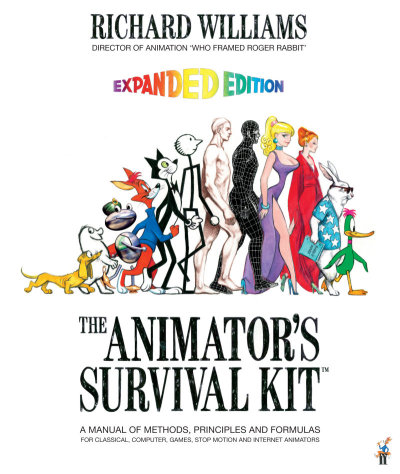
Richard Williams' "The Animator's Survival Kit: Expanded Edition" augments the original with 35 pages of additional material.
The first edition was exhaustive, especially in its specific analysis walks and other actions. It's a great resource for advanced study ("Timing for Animation" is a superior introductory text).
The new information is in line with the Williams' earlier writing. The expansion wasn't necessary but it is welcome. This is a book which attempts to be a bible of animation process -the more information attached in an orderly manner, the more successful the book is.
Harold Whitaker and John Halas' "Timing for Animation" has been my favorite "how to" book on animation for many years. It gives you enough information to see how its done without overexplaining. It keeps things basic, yet manages to impart the fundamental complexities of the process.
For example
"To express depression, the charater must appear to have no energy. His body droops forwords, his head hangs on his chest, his knees sag and his movements are slow, with frequent long holds and sighs. Anything that can be used in the drawing to convey the feeling of depression should be used --the hair and the clothes hang limp, perhaps the hat sinks, and a general lightness of step."
You are given the idea, then shown a simple execution.
Some other bits, such as walks or effects animation, are given a little more step by step detail. Overall, its a breezy read and a top reference source.
For many years the book was out-of-print. Focal Press republished it in the late 1990s. For the revised edition, Tom Sito was brought on to add to the original. I'm a great fan of his "Drawing the Line" and recommend it not just to animators but to anyone interested in American cultural history.
His contributions to the new edition seem minimal. There's not much to improve on. A few pages are added concerning digital process -tacked on, more like it, in a seemingly craven attempt by the publisher to make this title "relevant".
More telling (from a cultural standpoint) are the added pages on storyboarding and editing. Is this because animation work in the United States has evolved into shipping boards to Asia and editing the work sent back?
The greater letdown of this edition is the re-design. It's now on glossy stock with a weak sans serif font, there's a colored tab along the top that is unnecessary. Layouts are switched around to be less clear and the incorporation of new art (a few images from Bill Plympton, plus others) is more distracting than enlightening.
Regardless, it's an important piece of any animation library.
Richard Williams' "The Animator's Survival Kit: Expanded Edition" augments the original with 35 pages of additional material.
The first edition was exhaustive, especially in its specific analysis walks and other actions. It's a great resource for advanced study ("Timing for Animation" is a superior introductory text).
The new information is in line with the Williams' earlier writing. The expansion wasn't necessary but it is welcome. This is a book which attempts to be a bible of animation process -the more information attached in an orderly manner, the more successful the book is.
Monday, February 15, 2010
Choose Influence
Watch Gena Rowlands around the 3:30 mark of this clip from John Cassavetes' "Woman Under the Influence".
She loses her shoe. She continues without altering the general blocking of the scene or breaking character. If anything, this allows her to turn an expository scene into a little bit of reality.
It's a minor disaster, losing your shoe while in a hurry."
Now the 3:30 mark from Igor Kovalyov's "Milch"
A woman drops a suitcase while running for her ride.
This is a greater disaster than losing your shoe, and in the context of the film more emotionally stressful.
The woman here stops, mechanically picks up the clothes, and continues on her way. It's an opportunity to demonstrate the emotional state of the character, to make a connection.
Sure, it's unfair to compare something to Gena Rowlands in one of the greatest character performances on film. We can learn from it, though. It takes more drawings, it takes more work -but its that work which transforms something from a beautiful testament to animation art production into a moving work of film.
Thursday, February 4, 2010
Animation or Not
I've probably shared this story before, but it's a good one so I'll share again.
Tissa David tells how she came to New York from Hungary via Paris with no other dream than to animate for UPA.
She went up to their offices at 666 Fifth Avenue with a portfolio. "We may have work in the trace and paint department." "No, I'm an animator." That was kind of shocking, since women were not considered to be animators in 1958. But her foreignness somehow outweighed her femininity and she was told that Grim Natwick just fired another assistant and he might need another. So she was introduced to Grim, and said he'd work with her -falsely claiming they both spoke a little German to make up for her lack of English and his non-existent Magyar -if she could answer one question:
"What is animation?"
"Animation," she stuttered, "is animation."
Taken aback, "I've been asking people that question for 30 years and that's the best answer I've gotten yet."
Grim Natwick, one of the principle architects of this field, was searching for the meaning -the spirit- of his craft.
I'm nowhere near Grim on the talent meter, but I could probably out-talk him in any language neither of us knew. So I've talked it through some, and in light of James Cameron's assertion that his film "Avatar" is not animation thought I'd come to his defense.
Let's look at the world of being made of two things: nouns and verbs. (forget all those pesky adverbs and prepositions)
Nouns and verbs. Form and process.
Painting is form. Watercolor is process.
Travel is form. Running is process.
Film is form. Animation is process.
The debate on whether motion capture is animation is seeded in the feeling that calling it animation is "good" or "bad". There is no value to the term it's simply a process.
To define animation, you can look at what distinguishes from other processes of the form. The most obvious one is live action -in which thousands of images are captured in camera, altered through lab processes and projected in a new state.
If capturing the image is paramount to the form -and in film it is -the manner in which that image is captured will define subsets of process.
Here's where history comes into play. At an early point, it was discovered that imaged can be recorded onto film through a temporarily stopped camera. This is a clear break in process. In order for this process to meet the requirement of form, images must be manipulated one frame at a time.
It's clear, "animation" is the frame by frame manipulation of images for the film form.
What about puppets? Seems like a live action process.
How about clay? Seems like animation.
How about this swooshing logo? Wait a second...
Swooshing logo. Like this:
There's a different animal. Some images were created/captured single frame, but most were developed through trickery. Not exactly animation, not exactly live action.
This is a middle way: motion graphics
It can be created using crafted elements such as the logos above, or live action elements:
The process of animation has always been riddled with shortcuts -cycles, pan and scans, reused art, and rotoscoping. All of those are components of the process. As Richard Williams says "Animation is an extension of drawing", with that in mind drawing develops with tracing and with model study.
Rotoscoping is still a single frame process, therefore animation.
Along comes this technology. Motion capture. Is this something new? Neither fish nor fowl? It may be.
It's not animation, that's for sure. It's not a single frame process of creation -no matter how much re-rigging needs to be done. In that regard it's similar to flying logos, it's akin to motion graphics. Information is used and technology (whether its an optical bench, motorized camera, video generator, or computer) creates a picture from the inputs by interpreting the missing information.
At the moment, motion capture seems an awful lot like motion graphics. But let's look at the original definition of live action: "thousands of images are captured in camera, altered through lab processes and projected in a new state." Couldn't this just as accurately define "motion capture".
One thing it doesn't resemble is animation.
Wednesday, February 3, 2010
I Didn't See That Coming
I've been re-watching Satoshi Kon films lately. From one picture to the next he make remarkable jumps -not just as an animation director, but as an artist and writer.
On Sunday at the Dancing for Disney screening at Lincoln Center's Dance on Camera festival I dutifully screened "golden age" Disney shorts, impressed by the technical execution but thoroughly bored by the films themselves.
The worst thing something can be is boring.
Why is "Millennium Actress" compelling when a Goofy "How to..." short is a chore? For all the flair and craft within the Disney product it lacks a fundamental attribute: the ability to surprise.
For all the crappy animation in "Perfect Blue" it's engaging. If being boring is the worst thing possible, one of the best feelings watching a movie is when you think "I didn't see that coming" but remain wholly with the piece.
Friday, January 29, 2010
The World In Motion
In a Saints inspired drunken reverie, my high school friend Christine Horn sent this link all the way from New Orleans!
It's obviously motion capture, but neither the technique nor the design (which is pretty good) are what I find interesting. And yes, it is a few years old.
It was displayed in loops at Issey Miyake boutiques.
Fran Krause made a remark on a panel at Ottawa about abstract film. He was at his parents house when the screensaver popped on their computer. "It's like Stan Brakhage or Norman McLaren!"
In a way yes. Graphically, the liberties won by abstract art and animation have pervaded culture.
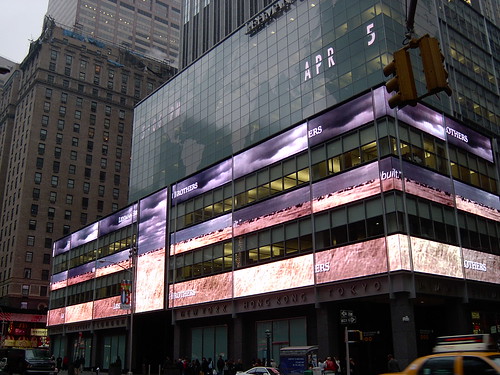
In essence, not really. At its simplest (and generally speaking) abstraction in animation asks you to observe. Most instances of industrial animation or animation in architecture are meant to be unseen. To be wallpaper for the 21st Century.
Lehman Brothers Building, 48th Street and Broadway
The Miyake graphics serve as both a moving wallpaper and an exploration of design and motion. Abstraction integrated into our expensive shopping sprees.
Tuesday, January 26, 2010
The Horror! The Horror!
Our friend Steve Kerper forwarded us this trailer which was produced at Laika.
Steve has partnered with the film's producer, Bernie Goldmann on a few projects.
Bernie, who was a producer on "300", initially questioned whether animation was a viable technique for a horror film.
Casting aside the obvious shortcomings of the trailer (the second year Maya student camera work, why are two people sitting in a giant empty space when monsters are hunting them?, how much good will that crowbar do if she's not changing tires?) the question of "appropriate technique" is a good one.
There have been a few feature length animated films to touch on horror. Most notably Satoshi Kon's "Perfect Blue" and the Japanese classic "Vampire Hunter D". The French anthology "Fear of Dark" comes close too. These offer more cerebral scares than the classics of the genre not even approaching the primal fear conjured by "Night of the Living Dead" or "Halloween". Even the psychological terror of films like "Rosemary's Baby" and "Repulsion" is leagues beyond any attempts with animation.
The horror film's power comes from psychology. It comes from the viewer's identification with the actor/character and the subsequent stirring of pity and fear in the viewer.
Animation inherently alienates the viewer from the film -the barriers against that same identification are too high.
Saturday, January 16, 2010
See This! Somehow!
First order of business.
We've decided to start using our Twitter account. twitter.com/asteriskpix
Not exactly sure how yet, since animation is a pretty stationary profession. Probably just "breaking news" like when films screen or shows or broadcast. Maybe some winning one-liners from around the studio such "Stupid kid, there's no such thing as a penguin version of Candyland."
We figure it puts us in position for a profile the next time someone wants to do a media story on social networking.
***********
On Sunday, Kristin Worrall took me to see "Flooding with Love for the Kid" at Anthology Film Archives.
Apart from the sound effects she contributed -usually via email conversations "I need the sound of crawling in bat shit on the floor of a cave." -the entire piece was singlehandedly made by Zachary Oberzan. I guess the men and women who built the equipment and wrote the software helped in their own way too.
And the guys who constructed his 220 square foot apartment.
The film is an adaptation of "First Blood" -the novel which also spawned the Stallone "Rambo" series.
Nina Paley was amongst the first people to whom I recommended the film. The DIYness is analogous to "Sita Sings The Blues", although significantly less polished. She didn't hate it, in fact, she wrote a nice little blog post which reminded me that I wanted to do the same.
Here's a "making of" video:
So in my blogging laziness, the run at Anthology has ended.
Copies are available from Zach himself.
"I like to funny drawings", you say, "What does this guy taping around naked in his apartment have to do with me?!?" Legitimate question.
In the above "interview" -and obvious in the movie itself- he talks about how in his first short films he aimed for slickness. For professional perfection. Here, he says, he was having so much fun that perfection wasn't a goal. The joy is apparent.
In using minimal tools and resources, he make a connection to the character of Rambo who also had no resources beyond his own ingenuity. He created a language of filmmaking to match and elevate the content.
Its a brilliant example of what Richard Williams calls "sophisticated use of the basics".
Speaking of Nina, she stars in this short documentary on Intellectual Property. Bill Plympton is makes an appearance to briefly give another point of view.
I don't hold her militant position, but I do think that American Copyright law needs some serious reform.
We've decided to start using our Twitter account. twitter.com/asteriskpix
Not exactly sure how yet, since animation is a pretty stationary profession. Probably just "breaking news" like when films screen or shows or broadcast. Maybe some winning one-liners from around the studio such "Stupid kid, there's no such thing as a penguin version of Candyland."
We figure it puts us in position for a profile the next time someone wants to do a media story on social networking.
On Sunday, Kristin Worrall took me to see "Flooding with Love for the Kid" at Anthology Film Archives.
Apart from the sound effects she contributed -usually via email conversations "I need the sound of crawling in bat shit on the floor of a cave." -the entire piece was singlehandedly made by Zachary Oberzan. I guess the men and women who built the equipment and wrote the software helped in their own way too.
And the guys who constructed his 220 square foot apartment.
The film is an adaptation of "First Blood" -the novel which also spawned the Stallone "Rambo" series.
Nina Paley was amongst the first people to whom I recommended the film. The DIYness is analogous to "Sita Sings The Blues", although significantly less polished. She didn't hate it, in fact, she wrote a nice little blog post which reminded me that I wanted to do the same.
Here's a "making of" video:
So in my blogging laziness, the run at Anthology has ended.
Copies are available from Zach himself.
"I like to funny drawings", you say, "What does this guy taping around naked in his apartment have to do with me?!?" Legitimate question.
In the above "interview" -and obvious in the movie itself- he talks about how in his first short films he aimed for slickness. For professional perfection. Here, he says, he was having so much fun that perfection wasn't a goal. The joy is apparent.
In using minimal tools and resources, he make a connection to the character of Rambo who also had no resources beyond his own ingenuity. He created a language of filmmaking to match and elevate the content.
Its a brilliant example of what Richard Williams calls "sophisticated use of the basics".
************
Speaking of Nina, she stars in this short documentary on Intellectual Property. Bill Plympton is makes an appearance to briefly give another point of view.
The Revolution Will Be Animated from Marine Lormant Sebag on Vimeo.
I don't hold her militant position, but I do think that American Copyright law needs some serious reform.
Friday, January 8, 2010
Three And A Half Rooms
Poetry and animation share fundamental similarities. Both rely gesture, rhythm, and excel in short form.
The union of the two has produced many rewarding films, Bruce Alcock's "At the Quilte Hotel", Michael Sporn's "Hunting of the Snark", numerous films of Billy Collins' work ("The Dead", "Forgetfulness"), and Martha Colburn's chaotic interpretations from the 1990s immediately come to mind.
In making a film around Nobel Prize winning, Poet Laureate Joseph Brodsky relying on animation is a smart direction. The animated bits of Andrey Khrzhanovsky's "A Room And A Half" (running at The Film Forum for two weeks beginning January 20) are outstanding. But they are too few and the rest of the film is just a muddle.
An overlong muddle, clocking in at over two hours. Demonstrative of the Russian mania for bigness, I suppose. Cut this film in half -start by removing the unnecessary and disturbing framing device of the poet's imaginary return to his homeland -and it could be very good. Instead it rambles -in a bad way -and rolls on for more than 20 animation free minutes after the second or third you think "OK, this is really the end."
Brevity. That's what poetry is about.
Brevity. The film is structurally unsound.
The structural issues are further compounded by subtitling. This is a film, if there ever was a film, that would great benefit from dubbing.
The animation is beautiful. That's the one thing there's too little of.
The union of the two has produced many rewarding films, Bruce Alcock's "At the Quilte Hotel", Michael Sporn's "Hunting of the Snark", numerous films of Billy Collins' work ("The Dead", "Forgetfulness"), and Martha Colburn's chaotic interpretations from the 1990s immediately come to mind.
An overlong muddle, clocking in at over two hours. Demonstrative of the Russian mania for bigness, I suppose. Cut this film in half -start by removing the unnecessary and disturbing framing device of the poet's imaginary return to his homeland -and it could be very good. Instead it rambles -in a bad way -and rolls on for more than 20 animation free minutes after the second or third you think "OK, this is really the end."
Brevity. That's what poetry is about.
Brevity. The film is structurally unsound.
The structural issues are further compounded by subtitling. This is a film, if there ever was a film, that would great benefit from dubbing.
The animation is beautiful. That's the one thing there's too little of.
Wednesday, January 6, 2010
Book Report - Disney Archive: Animation
I don't like giving the D Corporation any money.
They've been nothing but jerks in all of my dealings with them. I understand "business" and trying to get the most product for the least possible (although that's not a mantra I personally adhere to), I don't understand arrogance, stupidity, or insulting your contractors. I don't understand, as in one of our projects, refusing to give away nothing for something. "Nothing" is what the potential of a project has. If there's no series, the "back end" or whatever is nothing. If the show's a hit, there's more enough money to make everyone richer -that includes the people who make the show.
But enough of my grousing.
The "Archive Series: Animation" book they've just published under the Disney Editions imprint is beautiful. I can't recommend giving them any money, but I would recommend stealing it from your local theme park. The night in prison and the 40 hours community service are worth it if you get to keep the book.
The further along the production pipeline a Disney film progresses, the more the art degenerates. This is true of most drawn animation (John & Faith Hubley's films are a great exception) but it's especially pronounced in this studio's work.
It's a commendable book, crediting animators for their drawings, including drawing by Art Babbit who's legacy has been shamefully neglected after his rancorous departure from the company line.
One can see the general style of animation evolve through the generations of animators, as well as the individual hand of each artist. To me, the work from the late 30s through the mid 40s is the most appealing. This is where they did humans well -humans as humans, not cartoons. Grim Natwick's Snow White may be a little stiff in comparison to Hal Ambro's Wendy from "Peter Pan" but I just like it better.
The same can be said for Robert Stokes' Queen from "Snow White" compared to Marc Davis' Cruella de Vil.
The latter is probably the most appealing villainess after the Queen and the drawing is great -I'd take it in a second -but I'd take Snow White first.
As the book showcases current work, it's interesting to see the looseness the animators give their drawing. The assistants are handed a lot to figure out. This comes, in part, from the busyness of the character design -look at all that stuff on John Silver's face! Look at the musculature visible on his hand! The collar, and the apron, and the cuffs!
Seeing how these animators work, it's a wonder why they're working on films in this 1940s style.
Glen Keane's "Beast" from "Beauty and the Beast" (I'm a snob, I know, but I always think how superior Cocteau's telling is) has a passing resemblance to Tytla's "Night on Bald Mountain" -but Tytla's drawing is restrained. It fits with the process used to create the film. It's like a running back picking up a free blitzer so that the other guys can execute their assignments. The looseness and vitality of Keane's drawing, which I love, feels like it has little to do with what the drawing will ultimately look like on screen. It's as though he's making another film.
For the record, I think I would prefer his version probably not over Cocteau's, though.
The most creative successful Disney films of recent times are, in my opinion, "Mulan" and "Lilo and Stitch". It's no coincidence that these two drift from what the Corporation has defined as "Disney style" towards a method that was closer to the process of the studio in the 30s and 40s. In those times, the films were developed with the animators voices, catering to their draughting styles. In the modern "princess" films, great animators are trying to fit into a 60 year old mold that is hardly appropriate for their work.
I hadn't meant to go on and on like this. It's a good book and evokes a lot of thoughts even on the passing glance I meant to give it before posting.
They've been nothing but jerks in all of my dealings with them. I understand "business" and trying to get the most product for the least possible (although that's not a mantra I personally adhere to), I don't understand arrogance, stupidity, or insulting your contractors. I don't understand, as in one of our projects, refusing to give away nothing for something. "Nothing" is what the potential of a project has. If there's no series, the "back end" or whatever is nothing. If the show's a hit, there's more enough money to make everyone richer -that includes the people who make the show.
But enough of my grousing.
The "Archive Series: Animation" book they've just published under the Disney Editions imprint is beautiful. I can't recommend giving them any money, but I would recommend stealing it from your local theme park. The night in prison and the 40 hours community service are worth it if you get to keep the book.
I'd never seen Ham Luske's "Goddess of Spring". Beautiful drawings!
The further along the production pipeline a Disney film progresses, the more the art degenerates. This is true of most drawn animation (John & Faith Hubley's films are a great exception) but it's especially pronounced in this studio's work.
It's a commendable book, crediting animators for their drawings, including drawing by Art Babbit who's legacy has been shamefully neglected after his rancorous departure from the company line.
One can see the general style of animation evolve through the generations of animators, as well as the individual hand of each artist. To me, the work from the late 30s through the mid 40s is the most appealing. This is where they did humans well -humans as humans, not cartoons. Grim Natwick's Snow White may be a little stiff in comparison to Hal Ambro's Wendy from "Peter Pan" but I just like it better.
The same can be said for Robert Stokes' Queen from "Snow White" compared to Marc Davis' Cruella de Vil.
The latter is probably the most appealing villainess after the Queen and the drawing is great -I'd take it in a second -but I'd take Snow White first.
As the book showcases current work, it's interesting to see the looseness the animators give their drawing. The assistants are handed a lot to figure out. This comes, in part, from the busyness of the character design -look at all that stuff on John Silver's face! Look at the musculature visible on his hand! The collar, and the apron, and the cuffs!
Seeing how these animators work, it's a wonder why they're working on films in this 1940s style.
Glen Keane's "Beast" from "Beauty and the Beast" (I'm a snob, I know, but I always think how superior Cocteau's telling is) has a passing resemblance to Tytla's "Night on Bald Mountain" -but Tytla's drawing is restrained. It fits with the process used to create the film. It's like a running back picking up a free blitzer so that the other guys can execute their assignments. The looseness and vitality of Keane's drawing, which I love, feels like it has little to do with what the drawing will ultimately look like on screen. It's as though he's making another film.
For the record, I think I would prefer his version probably not over Cocteau's, though.
The most creative successful Disney films of recent times are, in my opinion, "Mulan" and "Lilo and Stitch". It's no coincidence that these two drift from what the Corporation has defined as "Disney style" towards a method that was closer to the process of the studio in the 30s and 40s. In those times, the films were developed with the animators voices, catering to their draughting styles. In the modern "princess" films, great animators are trying to fit into a 60 year old mold that is hardly appropriate for their work.
I hadn't meant to go on and on like this. It's a good book and evokes a lot of thoughts even on the passing glance I meant to give it before posting.
Tuesday, January 5, 2010
Goode Enough?
First, it's Tissa David's birthday today.
I can't express how fortunate I am to know her and have worked with her.
I can't express how much better she has made the world. Happy Birthday, Tissa! Many more!
Like most people I didn't catch a second of Mike Judge's "The Goode Family" when it aired this fall on ABC. Likewise, I suspect many of those people who missed it would agree that Mike Judge is a singular writer and father of characters.
Comedy Central has picked up the show for syndication. Business-wise its a sensible move, see how the reruns rate and pick up a second season at a cut price if its successful. Coming off "King of the Hill", an original Mike Judge development could command a substantially higher producer fee than a second run program would.
The show has been compared negatively to its predecessor, and rightfully so. "King of the Hill" began on a similar note -knowingly mocking Hank Hill and the residents of Arlen -before finding voice in Hank Hill's flawed but admirable character.
ABC was unwilling to give the show enough rope to find a similar voice. Under other circumstances, that would be understandable. Given the track record of Mike Judge, compared to the cost of development and the first season, playing out another 13 episodes, maybe another 26 scripts makes a lot sense.
I didn't enjoy the show, let's be clear (but I don't enjoy most half-hour television, either). The voice work, in particular, was a flight or two down from the top notch work on "Beavis and Butthead" and the even better "King of the Hill". From a business/programming point of view, ABC's cancellation shows a distrust of animation. Success on Comedy Central will only help with the economic viability of character/script based animation for adults.
I can't express how fortunate I am to know her and have worked with her.
I can't express how much better she has made the world. Happy Birthday, Tissa! Many more!
from John Canemaker's Raggedy Ann book
**************
Like most people I didn't catch a second of Mike Judge's "The Goode Family" when it aired this fall on ABC. Likewise, I suspect many of those people who missed it would agree that Mike Judge is a singular writer and father of characters.
Comedy Central has picked up the show for syndication. Business-wise its a sensible move, see how the reruns rate and pick up a second season at a cut price if its successful. Coming off "King of the Hill", an original Mike Judge development could command a substantially higher producer fee than a second run program would.
The show has been compared negatively to its predecessor, and rightfully so. "King of the Hill" began on a similar note -knowingly mocking Hank Hill and the residents of Arlen -before finding voice in Hank Hill's flawed but admirable character.
ABC was unwilling to give the show enough rope to find a similar voice. Under other circumstances, that would be understandable. Given the track record of Mike Judge, compared to the cost of development and the first season, playing out another 13 episodes, maybe another 26 scripts makes a lot sense.
I didn't enjoy the show, let's be clear (but I don't enjoy most half-hour television, either). The voice work, in particular, was a flight or two down from the top notch work on "Beavis and Butthead" and the even better "King of the Hill". From a business/programming point of view, ABC's cancellation shows a distrust of animation. Success on Comedy Central will only help with the economic viability of character/script based animation for adults.
Saturday, December 19, 2009
Wherefore?
It's been almost a year since I began daily postings on this site. Actually, I thought it was a year from today -but a few days were skipped in late December.
In any event, I wanted to celebrate with a post seemingly unrelated to animation.
This week, my friend Kristin Worrell (who's done some audio for us in the past) invited me to her theater company's show at The Kitchen.
After many years, I've grown a distrust of theater. The form was the first art that I loved, before movies or music or radio or anything else. Seeing so much bad, bad work, though, would make any person reticent to spend 90 minutes squirming on an uncomfortable chair in the dark.
I've also learned to trust bright people. Generally, (the massive shortcomings of the current administration's first year notwithstanding) they won't give you a bum steer.
Sometimes they'll give you a Golden Calf.
The Nature Theater of Oklahoma's "Romeo & Juliet" at The Kitchen is, at the very least, some Blue Ribbon Bull.
Those who've been fortunate enough to see "Sita Sings the Blues" (New Yorkers will again have the opportunity during its upcoming run at IFC) will recall the three characters trying to recount the story of Rama and Sita as they remember it.
This production jumps from a similar conceit. The director built monologues from phone calls of people recounting from memory Shakespeare's story. The confessional phone call being a staple of another of America's great artists, Joe Frank.
There's comedy -like in "Sita Sings the Blues" -but the production quickly transcends comedy. We're rooting for the person to get the story right, wanting to help them out. This creates a profound, and wholly theatrical, intellectual engagement with the audience. We follow their trains of thought into personal, illuminating, and sometimes frightening places.
The stylized performance of the actors, their self-consciously "Shakespearean" presentations set in Summer Stock stylized mock proscenium simultaneously obscure and explicate the original script. The result is akin to what good animation does, it references the way something behaves and then shows it to you in strange way that seems perfectly natural.
Personal stories, layers of literary irony, comedy, romance. This is a moving and magical production. Each moment is beautifully orchestrated, although I thought the third act was a little too long even that was saved by the perfect little music cue (once you learn the source of the music, the brilliance is eye popping). The epilogue, after an evening of tangents and botched recollections can bring you to tears.
It's reminder of why I loved theater, and a prod at what the technique of animation can do with the right creative intent.
The show runs until January 16th.
Tuesday, November 17, 2009
Expectations
My Dog Tulip screened in Ottawa. I was a little disappointed. This was no Still Life With Animated Dogs or Drawn From Memory -Paul Fierlinger's masterpieces. Where was the personal revelation? Where was that halting voice?
It didn't help that a festival setting caters to quick and the flashy, and that I get particularly waterlogged after two or three days of non-stop screenings.
Film Forum hosted a special screening of the film last night.
The personal revelation may be dialed back in this film, and the narrator may not speak with Fierlinger's accent and his words may be purple but the voice is clearly his.
The format is in line with many of Fierlinger's films -first person narratives.
Going in, I was expecting this film to be something it wasn't. On second viewing, it's a beautiful meditation on love and companionship. I wonder what it will be the third time.
Monday, November 16, 2009
Let Me Write That Again
Expectations are important in film.
A film must set and meet (and hopefully exceed) expectations in the viewer.
Conversely, pre-conceived expectations in the viewer typically do disservice to the film.
Wes Anderson has been a leading figure in a Cinema of the Leisure Class. His films from "Bottle Rocket" to "Darjeeling Limited" celebrate priviledged parties in a world with little consequences while showcasing the director's really cool record collection. The result -films that are generally enjoyable, though not particularly likable. Like the kid with easy good looks, quick wit, and a nice car who can never remember your name.
"Fantastic Mr. Fox" uses almost all of Anderson's tropes -characters staring blankly into camera, cool pop soundtrack (primarily Beach Boys here), smarter than you leads. Missing is the overcranked slow motion shots -thankfully, (once is cute, twice is pushing it, three times is just garbage).
The technique, a Rankin Bass style stop motion, recalls the backyard home movies budding filmmakers create with their action figures and dolls. The glossy film school gimmicks of "Rushmore" are in the distance.
What does this all add up to? "Fantastic Mr. Fox" is a remarkable achievement. The peculiarities of the technique reign in the director's indulgences. The director's "auteur" vision opens previously uncharted territory for films that use animation.
I've heard some animators complain about Wes Anderson rarely visiting the shooting set. I suspect these are either amateurs or pixel pushing cubicle monkeys with little experience working with creative animators. Animators don't need a director looking over their shoulders eight hours a day, they need a person to tell them what needs to be done and give them the space to do it.
And, really, the proof is in the results. The animation, under the supervision of Mark Gustafson (who, if I recall correctly, was a big cog in the Will Vinton machine) is exceptional. Compare to the overwrought flourishes of "Coraline" which moves around so much but says so little, the idiosyncracies of the animation in "Fantastic Mr. Fox" are not simply hurky-jerky but statements of purpose. The animation reveals truths about the characters.
Let me write that again. In "Fantastic Mr. Fox", the animation reveals truths about the characters.
When the foxes eat, they sit down properly, tuck in their napkins then voraciously devour their food leaving a mess of flotsam and crumbs. It's funny. It's simple, goofy animation. It's a pure gesture that reminds us -they're wild animals.
If he releases another film like this Wes Anderson may vie with Richard Linklater for the best director of animated films working today.
Wednesday, November 4, 2009
The Worst Book About Animation Ever
Not to sound too full of complaints, because really, who needs it?
We just got in "Historical Dictionary of: Animation and Cartoons" by Nichola Dobson, part of a series edited by Jon Woronoff for Scarecrow entiled "Historical Dictionaries of Literature and the Arts."
Other volumes include "American Radio Soap Operas", "Japanese Traditional Theater", and "Sacred Music". In this light "Animation" is a broad subject. I'm glad the editor understood the value of the field's inclusion. The value of this volume, however, is minimal.
It's a sad waste of a possibility. Even worse than no volume at all.
Whenever I look I look at an animation history book, I flip to the index and look for "Tissa David", I'll then look for "Blechman". Maybe it's West Coast centric, so I'll see what they say about "Bob Kurtz" or "Fred Wolf" or "Bill Littlejohn". OK, what insights or information do they have on "Frederic Back"? How about "Harry Smith"?
How about "none"? Not even "Bill Melendez". Not even -I shit you not- "Richard Williams".
This book references none of them -and more!
It's a dictionary, insight isn't required. Just a simple: Fierlinger, Paul (1936 - ) director of numerous independent and commercial shorts including "Teeny Little Super Guy" for CTW, "Amby & Dexter" for Nickelodeon and "Drawn From Life" of Oxygen. He is best know for his longer films including "Drawn From Memory", "Still Life With Animated Dogs", "A Room Nearby", and "My Dog Tulip." These are marked by strong narration, often by the animator himself, and deep personal revelations.
There. Was that so hard? No. I did it in two minutes while talking on the phone.
Quizzically, there is an entry for J. J. Sedelmaier Productions. Good for him, I know he works hard to get his name out there. But there's no Curious Pictures, no Passion, no Filmteknarna nor Jonas Odell, no Duck Soup, no Wildbrain nor Colossal.
Does this same series' "Historical Dictionary of African American Theater" exclude Ntozake Shange, Derek Walcott, August Wilson or Suzan-Lori Parks in favor of page after page of Al Jolson and blackface "mammy" shows? Why, then, would the volume on animation -ANIMATION AS ART - exclude dozens of men and women responsible for making this craft an art in favor of entries on Trey Parker and Matt Stone (who's work I love), The Muppet Show, and Jonny Quest?
Yet no Suzan Pitt, no John Canemaker, no William Kentridge.
Nichola Dobson's "Historical Dictionary of Animation and Cartoons" is a terrible and insulting book. A wretched, horrible waste of time. If you come across it in a bookstore, bring it to manager and tell them to ship it back to the publisher. The world would be better if it was never published.
I'm often reminded of the Winsor McCay (he made the book!) quote "Animation is an art. That is how I conceived it. But as I see what you fellows have done with it is making it into a trade. Not an art, but a trade -bad luck." Dictionaries and histories like this will forever relegate the technique of animation to a second rate pornography for children in the eyes of the public.
Subscribe to:
Posts (Atom)