Showing posts with label ny animation. Show all posts

Friday, April 29, 2011

Cartoons of Glory

This is an article from the November 3, 1986 New York Magazine that was in The Ink Tank pressbook.  I won't repost all the copy, click the images to read everything.

The photo on page one is from an MTV ID designed by Mark Marek. The actress is R. O. Blechman's mother-in-law.
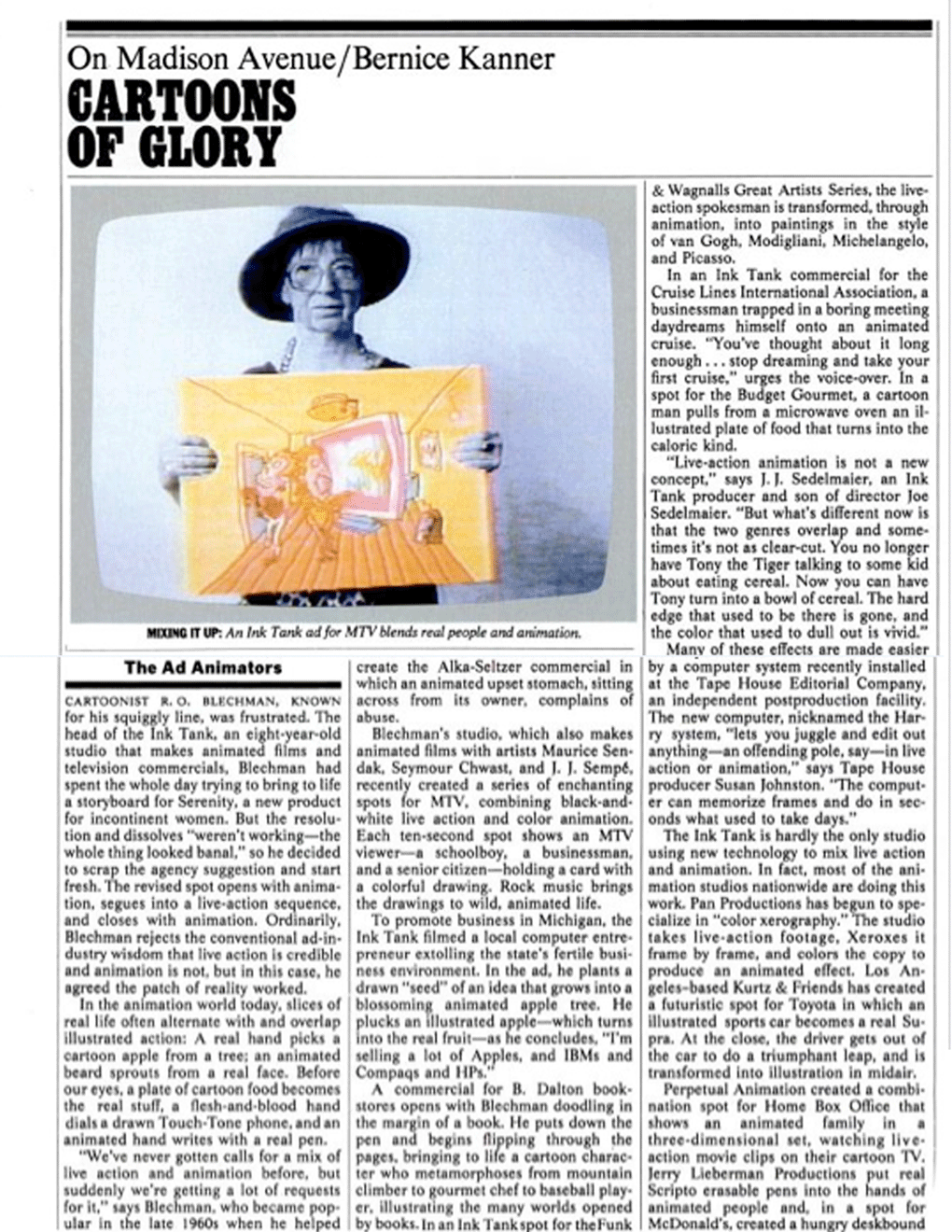

Cartoonist R. O. Blechman, known for his squiggly line, was frustrated.  The head of The Ink Tank, an eight year old studio that makes animated films and television commercials, Blechman had spent the whole day trying to bring to life a storyboard for Serenity, a new product for incontinent women.  But the resolution and dissolves "weren't working -the whole thing looked banal," so he decided to scrap the agency suggestion and start fresh.  The revised spot opens with animation, segues into a live action sequence, and closes with animation.  Ordinarily, Blechman rejects the conventional ad-industry wisdom that live action is credible and animation is not, but in this case, he agreed the patch of reality worked.
The article then discusses some of the studio's spots before getting to "a computer system recently installed at the Tape House Editorial Company... The new computer, nicknamed the Harry system, 'lets you juggle and edit out anything -an offending pole, say -in live action or animation.'"  That's the Paintbox system which would open a new chapter in special effects history.

Then:

Pan Productions has begun to specialize in "color xerography".  The studio takes live action footage, Xeroxes it frame by frame, and colors the copy to produce an animated effect.  Los Angeles based Kurtz & Friends has created a futuristic spot for Toyota in which an illustrated sports car becomes a real Supra...

Perpetual Animation created a combination spot for Home Box Office that shows an animated family in a three-dimensional set, watching live-action movie clips on their cartoon TV.  Jerry Lieberman productions put real script erasable pens into the hands of animated people...


...Buzzco Associates has created a series of ads combining  live action and animation: a cartoon vacuum cleaner hosing around real-life cans of Love My Carpet; real babies crying animated tears for WMET radio; an animated viewer watching live-action TV for Lifetime Cable; and a drawing of a made-up eye becoming a real eye for Aziza eye shadow...
Then Candy Kugel points out this sort of thing has been around forever but technology makes it easier.

 ...Nine years ago, Mark Zander Productions dropped comedian Bob Hope onto a remote oil rig operated by animated Texaco workers.  More recently Zander cast an animated basset hound in a chorus line of live dancers stomping and kicking for Hush Puppies shoes, and in a spot for Shick Plus  razors, planted a fuzzy white cartoon beard on the face of a real-life man. (The sudden appearance of the animated facial hair terrifies a crowd.)

Then there's some pretty banal history which tries to elevate itself by calling Walt "Walter Elias Disney".

The resurgence in commercial animation has been stimulated by advances in technology and by the work of artist like Blechman, who formed The Ink Tank in 1978 after producing an animated TV special. The Ink Tank's next project is an allegorical film The Golden Ass, which tells the story of a young man who, having been magically transformed into a donkey, struggles to regain his human form. The story recalls Blechman's award-winning TV film, The Soldier's Tale, in which a peasant soldier trades his fiddle to the Devil in return for great wealth, and find happiness only when the trade is reversed.

With big dollar advertising, Blechman feels he has made a personal Mephistophelian swap. In the sixties, he refused to advertise cigarettes, promote Muzak, or sell illustrations to Playboy. "But between these black and white poles lay a vast gray (and green!) world of commissions, and I did not know how to chart my course," he writes in his book, Behind the Lines.

Blechman has since learned. The Ink Tank is accepting more project than ever before -45 so far in 1986 -and many, like the Serenity ad, are animation-live action mixes. "Advertising is dead if it doesn't attract attention," says Blechman. "Mixing live action and animation does just that."

Sunday, March 20, 2011

Color Blast From The Past

I remember running out of middle green paint one Friday morning around 1997.

Chances are Cartoon Colour wouldn't be able to make the shipment for the weekend crew (cel painting -especially on commercials was often a seven day a week affair).

By that time New York Central Art Supply was the only place  you could get the stuff locally.  Pearl Paint still carried black and maybe white.  F&B Ceco carried some other supplies like acetates but even those were in short supply.

So it was a little shocking to see this in Blick on Bond Street.


Maybe they think it's still 1998, it would have been in relatively high demand with Buzzco, Curious Pictures and Michael Sporn Animation all within a few blocks at the time -not to mention NYU's always interesting film animation program.

I wonder how much they Cel Vinyl they sell today and who's buying.

Thursday, October 14, 2010

About Last Night

Yesterday afternoon I was telling Christina she should read Signe Baumane's blog, and she countered with a story of how Signe introduced her to PES at Patrick Smith's Christmas party when she was interning at Blend Films.

Signe pulled her over, gushing about what a great job she working on Bill Plympton's "Hair High" and graciously made the introduction.

Anyhow, the point is that Signe is amongst the friendliest, hardest working and (seriously) smartest people in animation.  She gave a presentation of several of her films at The Society of Illustrators last night.


She frames her presentation, like many of her films, with dispassionate talk about sex.

She says: "They say 'sex sells'.  It's not true, sex doesn't sell.  What sells is porn and I don't do porn."


Other pieces of wisdom:

"That's a problem.  I studied philosophy so I can justify whatever shit I make."

On virginity (probably applicable to her films): "You do it fast, or you don't do it at all."

On autobiographic "truth" in her films: "What is the truth?  What is reality? I'm interested in the story."


The screenings concluded with a brief (two or three minutes) excerpt from her current feature length film in production.  She's partially funded it by papier mache sculptures, partially with grants from NYSCA and the Jerome Foundation and is currently creeping towards her goal.

The excerpt demonstrated an integration of papier mache models with draw characters -a little reminiscent of "When the Wind Blows" visually.  There wasn't enough context or development within the sequence to make any statements on narrative.

Wednesday, June 16, 2010

New York Stuff

There are some weeks in New York when you can fill your social calendar with animation events.

The first of a few good ones was last night at SVA.  Frank Mouris presented some of his films under the auspices of ASIFA-East and Women in Animation.


Also this week, Tale at Galapagos in DUMBO on Thursday.  I haven't been to Galapagos (in any incarnation) since they were assholes to us on the shoot for Dr. Worm around 1999 but if you don't hold grudges over unwarranted professional hassles you should attend what looks to be an interesting show.

Then Friday, Patrick Smith is showing his new film at the 93rd Street Y in Tribeca.

Frank Mouris' talk reminded us how animated film, at one time, was closely connected to experimental film.  A short could have festival success, community acclaim and an appeal to the avant garde.

Tuesday, April 20, 2010

Provacative For A Reason

Last night Brian gave a talk to Michael Kantor's class at SVA's documentary film program.

Meanwhile, I was getting some education.  Gail Levin invited me to see Bill Plympton give a talk at the Writer's Guild.

Many of us in New York have seen him talk a number of times, but somehow he always manages to be fresh and entertaining even if he's preaching the same gospel about independent production.

Here told a very funny story of drawing Marilyn Monroe for his friend's high school student council campaign.  Over the loudspeaker the next day he was called to the principal's office as "The pornographer Bill Plympton."  When he returned to his classmates, he was suddenly transformed in their eyes -an "artist".

I mentioned to him that Gail did a documentary on Marilyn Monroe and he -gracious as always -gave her the drawing.

Here's a brief clip from his talk:

Friday, March 19, 2010

Too Much Animation Makes You Cranky

Animation screenings are generally exhausting and often discouraging.

This week were the final nights of screenings for the ASIFA East judging.

from "Why Does The Sun Really Shine?"

The rules for judging, if you don't know, are opaque and borderline nonsensical. One category screens per night, although stragglers and miscues will screen on other nights. People come in late, leave early. Given these variables, it would be good to know exactly how the winners are calculated. Are they averaged? Highest score wins? Either way, both are highly flawed given the loose nature of balloting.

Then there are the craft awards within each category. Voters circle which craft they find a film excellent in. Or they don't. Or they circle them all. How this is tallied is never revealed, although the manner of filling in the form gets explained several times throughout the evening.

a humorless corporate film from Flickerlab which refused to take its own advice about innovation.

On top of that, a significant number of attendees are SVA students. That's like letting the Presidential Election hinge on the Florida electorate. To be fair, even with this apparent majority the SVA bloc typically hasn't held significant sway in the final tally.

My number one personal peeve (the above are all practical problems) with the ASIFA East voting system was largely absent this year: the hooting cheers when certain names are announced to be screened. While I find any cheering at such screening impolitic and improper, applause before a picture even screens establishes a bias of celebrity which is completely unfair to "outsider" films. Superior films which don't get the inside track routinely miss out on the big ASIFA East show. This is probably typical for any festival/awards show but it doesn't mean it should be happily accepted.

Tuesday night featured Independent films (and one commercial work less than 2:00).


Tops for the evening was Stephen Neary's "Let's Make Out". Last year, I felt his "Chicken Cowboy" was the best student film. I didn't even make the connection until it was pointed out later.

Julie Zammarchi's film "The Passenger" is also good. That screened in Ottawa last year. She's worked very closely with Suzan Pitt over the years. It's evident in the design and certain animation tropes but the narrative style and subject matter are wholly her own.

I also appreciated two films from "The Paper Theater": "Annie's Circus" and "Puppy's Super Delicious Valentines Day Biscuits". They had a charm. Though unpolished, they were convinced of their idiom.

Another annoyance with the festival: a few entries were clearly in the wrong category. They were commissions. Either ASIFA needs to explicate what defines "Independent" or they should be serious about segregating the categories. Miscatagorized pieces are unfair to all the films.

Looking over the list now, there were more "OK" films than I remembered: John Dilworth's "Rinky Dink" (which is best once we get passed the surface Dilworthisms to core ideas that make up his films), Aaron Hughes & Lisa LaBracio's "Backwards", Edmond Hawkins "Spare Time", Elliot Cowan's "The Thing in the Distance" and others -all solid. Not enough "great" to make the evening stand out.

Wednesday was sponsored films over two minutes. This one, this was tough.

Mo Willems' "Don't Let The Pigeon Drive The Bus".  One film that didn't make you feel run over.

Not much in the way of filmmaking. Two Weston Woods pieces based on Mo Willems books were good -Mo's a brilliant guy, but the directors/animators of each are both talented: Pete List and Karen Villareal.

Buzzco's "It's Still Me!" was nice. At 15:00 it pushed patience's limits, but that's the nature of a commission -you've got requirements to meet. Beyond that, the film (about asphasia) falls back on the most severe forms as an example. It's not until deep within the piece is it clear there are many forms the disorder can take. It's a nice film, though.

"Hey, animation screening, what are you going to do to my patience?"

There were a bunch of They Might Be Giants films and pretty much every entry was devoid of filmic narrative opting for either music video-ness or single panel gags cut after cut.

Liesje Kraai and David Cowles "Why Does The Sun Really Shine?" was my favorite of the TMBG videos. Probably a little biased on that, as she works with us sometimes.

Oh, and the first film of the night was -I kid you not -a 14:00 minute film (Flash, ugly) convincing kids to eat broccoli.

Wednesday, March 3, 2010

Have A Cow!

Bill Plympton premiered his new film "The Cow Who Wanted To Be A Hamburger" right down the street at The Hill Country Barbecue.


One of my favorite aspects of Bill's films has always been the soundtracks. Maureen McElheron has been his longtime collaborator. She played a few songs.


Nicole Renaud is providing music for Bill's upcoming feature. She played two short sets on her accordion -with an almost one of a kind see through casing.


Bill is a gracious host and ran a good show. Every set was smartly introduced and ran smoothly.

He also made sure to bring his team on stage for a bow.


The film was a bit of a graphic departure, but still recognizably Plympton. The strong blacks and deep, flat colors are a nice look. After decades of great work, he still keeps experimenting.

Sunday, February 28, 2010

Everything is Provisional

In the early part of this decade one of animation's greatest living artists was living in New York as Columbia University's resident artist.


That this escaped the "animation community" is evidence of the insular, self referential natures of all groups.

Fortunately, the insular, self referential "art community" has not failed to take notice of William Kentridge.  Nearly a decade after his landmark exhibition at the Guggenheim SoHo, the MoMA now has  an even more impressive, more expansive show (originally mounted by the San Francisco Museum of Modern Art).

Here's the official exhibition site.

Many who work in animation will have gallery shows in attempt to expand their audience.  Often, this work has solid technical foundation and a level of "appeal" that animators are trained to go after.  Kentridge's work -his drawings hang in the main galleries of the show -have power.  Strong charcoals, kinetic viscera --impact.  First and foremost, Kentridge is a great artist.  Moving pictures is simply his primary means of communication.


Three of the galleries were wholly new to me -mostly work created in the last decade.  They mark a departure from what we may know as "Kentridge films".  Journey to the Moon is part homage to Georges Melies, but more a stepping stone for the artist to move into the otherworldly.  This pays off with his stirring treatment of Die Zauberflote in the next gallery which projects on 3 channels in succession.  Two of the projections are even in a sort of 3D.


It's an extraordinary exhibit.  The curators, the architects, the engineers, everyone who put it together should be proud.  Give yourself at least 3 hours to take it in, or plan on multiple trips.

The gallery for the older Soho and Felix series (which contains my favorite image of his -"Her Absence Filled The World") has this statement from the artist:

"Everything can be saved.  Everything is provisional. A prior action is rescued by that which follows. A drawing abandoned is revived by the next drawing... The smudges of erasure thicken time in the film, but they also serve as a record of the days and months spent making the film -a record of thinking in slow motion."
 Here's a bootleg clip from a theatrical performance of The Magic Flute directed by Kentridge, embedding is disabled. CLICK HERE to have your mind blown

Tuesday, February 16, 2010

Little Bloody Spots and Little Bits of Happiness

I'll hold back on editorial comments, and just offer straight reportage.

SVA (where they obviously teach their students to ask about money) hosted Yuri Norstein at their newly renovated theater on 23rd Street last night.  A full crowd came out to see the screen where I saw "Spiderman 2" many years ago.  I think we were working on "Between the Lions" at the time.


He explained a bit about his process, showing two of his three classic films: "Heron and Crane" and "The Hedgehog in the Fog".

"The Hedgehog in the Fog" confirms my position that the greatest animated films are fully composed (musically) before the animation begins.

He creates a script and storyboard (sometimes the board gets ahead of the script).  The board is worked out by seconds and he works to this time.

The film is shot on a multiplane downshooter with an oversized table.  The table size allows for a whole scene to be film with the camera moving into different fields, much like a set.

He does a dry run with his cameraman, testing light effects.  This takes about 1/3 the shooting schedule.

He then shoots the film by himself, operating the camera as well as animating.

The characters are made of cutouts, unhinged, of dozens of tiny pieces of art.


"Film is space, but not in a physical way.  Space in a more Eastern sense.  Space that moves behind the horizon further and further."

Rhythm of the work comes from the space.  In his films characters don't feel force or violence from the space.

The Hedgehog doesn't have much expression to his face.  The emotion comes from his relation to the space.


Black and white holds a strength that is fantastic compared to color.

Sound is half of the film if not more.

"There's a short line from the heart to the hand. The hand captures your feeling and you can not put that in a computer."

"The whole sense is not the material.  It has nothing to do with materials, but the character."

[sic contradiction]


On the character design for a lovely short film based on a Japanese poem.

"I often watch TV not to watch those idiot politicians, but to watch what I find visually interesting"

Sketched a conductor from TV.

"It's a lot easier to work on a physical level than on a sublime level."

Made his mouth a little crooked.

"Look at the details I took away."

"Please take a picture because I'm afraid that it'll all just blow away."

Thursday, December 17, 2009

Ho Ho

I admit, I don't like Christmas. There are lots of reasons which I won't go into here.

I do, however, like Christmas cards. Maybe because of a strange attachment to the postal service.

That same attachment may be why I dismiss digital "cards".

This one, though, is not only the nicest digital "card" we've gotten -it may top all of our dwindling number of physical cards as well.


Lisa Crafts made it for the New York Foundation for the Arts.

Friday, October 23, 2009

More Interesting Things By Others

Our friend and neighbor Bill Plympton has posted an animatic of his new short film.


He's open to suggestions for a title.


***********


Almost forgot this one.

Laurent Cilluffo started work on this in 1999 and finished it seven years later. It just made it online two weeks ago.


He writes that there are a few things he would do differently, but to me the singular design overcomes any animation shortcomings.

We worked with Laurent and his wife Valerie for several years at The Ink Tank.


*************


Pete Sluszka, who worked as an animator on "I Spy" produced by The Ink Tank, was one of four directors to make animation for The Decemberists "The Hazards of Love" "rock opera".

Foremost, it's not an opera. You know what makes something an opera? It's performed in an opera house or an opera company. That simple.

Porgy and Bess at the Met? Opera.
Tommy at the Meadowlands? Not an opera.

Sure there's gray area. Skiffle musicians in smokey club; not within the gray area.

In any event, it looks like an interesting project.

Here's a link to some video.

And an article with some more visuals and full credits.


***************


Annie Simpson used to work the front desk at The Ink Tank. Everyone had a crush on her.


She's just launched her website. You can see some of paintings and films there.


**************


And another old friend from The Ink Tank, Santiago Cohen, sent this postcard the other day.

Wednesday, September 16, 2009

New Book, New Panel

Panel last night at SVA in conjunction with David Levy's new book ANIMATION DEVELOPMENT: FROM PITCH TO PRODUCTION.

I started reading on the subway afterwards.  So far, its pretty good.  When I finish, maybe I'll post some thoughts.

Interesting enough panel featuring, David, Carl W. Adams from Clambake Animation, Janice Burgess who created "The Backyardigans", the preternaturally talented Fran Krause, and supremely opinionated Amid Amidi.

Someone asked if the panel envisoned an animated version of "The Sopranos" or "Mad Men" (*note: I've never seen either, but I get the point).  The panel didn't really.

What makes those shows -or "The X-Files", "Rome", "Six Feet Under" and others of pedigree -special?  They tell sophisticated stories which happen over course of months and years.

The American TV system doesn't have a place for this.  You can be either a ribald comedy or a kiddie show.  There's a small niche for action, but not much.

Japanese animation has had more sophisticated narrative structures since the 70s.  "Star Blazers" being a classic example.

Carl W. Adams and Janice Burgess

Janice Burgess: I'm not an artist, I work for a living.

Later.

Carl W. Adams: You wouldn't get a great writer then somebody who can't animate or draw very well...

Oh, really?


I don't make it too many ASIFA events.  It's interesting to see the turnout and hear the questions that students have.
It seems like they have a great concern for business, and were able to articulate some pretty good questions.  

Friday, September 4, 2009

J. R. Meet R. J.

As a child my name was "R. J."

That may have been the only hint that I was destined for a life in animation in New York.

I was looking at an older essay of John Canemaker which mentioned that J. R. Bray's studio -the first professional animation on the planet Earth -was on 26th Street.


Hey, our studio is on 26th Street! How cool would it be if we were at the same address?

Turns out they were a few blocks down on 23 E. 26th Street across from Madison Square Park. By 1914, when he took the offices, the area was no longer the outskirts of town. Less than ten years earlier, the first "Crime of the Century" took place a few doors down when Stanford White was shot dead in the rooftop restaurant of the (second) Madison Square Garden.

Gunplay aside, Mr. Bray had a superior location. I imagine the young Fleischers, Paul Terry, and dozens of other future luminaries would have appreciated the proximity to a restful lunchtime hangout as much as animators today. They may have even stood in line for an hour at a WWI version of Shake Shack.

While our work is a very distant relative to "Colonel Heeza Liar" and other Bray staples -I suspect he would have produced products closer to "Wonder Pets" or "Little Einsteins" if he were producing today -I do appreciate the geographic proximity to the ghosts of this haunted artform.

Wednesday, September 2, 2009

IN A CAN!

The big news of the D-Corporation acquiring Marvel reminded me of the first thing I ever did in animation.

I sent out an invoice for the "new" and "non-new" versions of an X-Men Pasta commercial. This would have been February 1995.

Brian produced the job at The Ink Tank. Igor Mitrovic did the animation. Amongst the production crew was Marina Dominis who, incidentally, has been working with us for several months on an upcoming project for PBS. Chef Boyardee was the client, Young & Rubicam the advertising agency.


Oh, and David Mazzuchelli did the layouts.

It was shot on film. You can see in the scene where the guy (I'm told he's Magneto -even though he doesn't look a thing like Sir Ian McKellen) how he shakes off register and the cels flare towards the bottom. I'll also note that "In a can!" is supposed to be the narrator. That never made any sense to me.

Brian tells me that the character models were a bit of an issue.

They would draw up the layouts and the Marvel Comics people would complain that they were off model. The production team would counter with a dozen tear sheets from comics only to be told -"Don't use that one!" Eventually they were given a "model book" containing a few dozen pages of characters that looked different in every pose.

That's one of the things people love about Marvel Comics -the artist's hand is always present.

After this spot, The Ink Tank was contracted for a "Street Sharks" commercial. JAWSOME! These were ugly, stupid things. I can't wait for the Miley Cyrus crossover.


The third was supposed to be a Spiderman pasta commercial. This would have been around 1997 probably, as I was closer to production. The bid went to now-defunct Magnet Pictures. Most of the crew who worked on the spots at The Ink Tank (with the exception of Sara Calagero) moved over there to work on it.

Tuesday, September 1, 2009

Play Hookey

The only way to account for the modest showing at Sunday's screening of Suzan Pitt's films would be to assume that everyone is waiting for the opportunity to skip work tomorrow to see them.


I'd seen "Asparagus" and "Joy Street" a few dozen times and "El Doctor" maybe two or three. The first time I saw "Asparagus" was actually in a film to tape transfer with Suzan -a story I'll save for my memoirs.

This was the first time I'd seen "Asparagus" on film, the first time since 1996 or so when it played at The New York Film Festival that I had seen "Joy Street" projected.

As much as I love these works, a TV monitor does them little justice. The art work and production are one thing, but moreover the pacing is cinematic. Television is a weak force, it needs constant stuff to keep our attention -quick cuts, sexy people, shouting people, jazzy graphics. Both "Asparagus" and "Joy Street" are diminished in that format. They don't really work. On screen, though, it all makes sense.

"Joy Street" on video can drag a little. In its natural environment the timing is flawless. The transitions from somber to whimsical to despair and ultimately joy all strike perfect tones and all happen in a particular space.


These are films which exploit the strengths of animation to create their narratives. They are artful, abstract and concrete, philosophic and fun.

Everyone should skip work tomorrow and go to Lincoln Center's Walter Reade Theater at 2:50. Walter Reade, along with the MoMA, is the best screen in Manhattan -the chance to see such beautiful work in ideal conditions should be too great to pass.

Tuesday, August 11, 2009

Dog Dreams

A few years ago I helped Bill Plympton with some mundane technical thing. Something to do with a DVD.

I offered to do it gratis, as a professional courtesy. Bill insisted -he would be making money from this endeavor and felt I should be compensated. He offered either $200 or a cel from his just completed "Guard Dog."

Not wanting money in the first I chose the artwork.

I hope I'm never so desperate that I'd chose cash over craft.


Had I made the other choice, that money would be long gone spent on candy and comic books, no doubt. Bill did ask me not to sell the art (he makes his living from it), but I wouldn't even consider trading a memento of my professional relationship to one of the giant figures of our field.

There was a little gathering at the Plympton studio to promote his newest DVD which contains "Guard Dog" and its follow up films.

Purchase your own directly from his studio.


*********


We've jokingly discussed the idea of having interns pay us for the privilege of scanning in our studio. Especially hearing some of the underhanded things other studios to their "interns", or even just guests who would like to look around.

Yesterday's New York Times featured an article on the paying-for-an-internship phenomenon. It turns out the company they site most frequently, University of Dreams, is in our building. While standing in the lobby, I've dreamt up many courses that this school could've had in it curriculum. None involved paying to work. Unless you have a broad definition of "work".

I think you need to be selective with whom you work, and I also think that artists deserve to be paid for their work. (Admittedly we've paid some people pretty badly, and there are few students that put in irregular hours for free -these flaws make us human) Those are a couple reasons why we don't jump head over heels at every student with a decent portfolio who wants to learn on the job.

In a few days will be posting some of our tips for "job hunting" as well.

Friday, July 24, 2009

Stars and Stripes Forever and Ever

Ed Smith entrusted me with a bunch of his papers, including a few union newsletters he edited in the 1960s.

The September 1964 newsletter has a page featuring Stars And Stripes Forever, a big commercial in its day.


The studio was then "engaged in producing a feature film, 'Howie'". "Howie", as far as I can tell, was never produced. There must be hundreds of films melting away in Fresh Kills that have their own unique stories to tell.

Friday, July 3, 2009

Monday, March 30, 2009

.02¢

The weekend started with Knowing and ended with $9.99.  Rock and Rule was sandwiched in between, but I don't have a clever way to include that.

What do Knowing and $9.99 have in common?

Australia.

Angels.

$9.99 is well-directed and well-written.  Like last year's Waltz with Bashir it uses animation to market an otherwise ordinary story (like Waltz with Bashir it also claims Israeli financing; good to see the US tax dollar put to work beyond bailing out billionaires).  And, as true in Waltz with Bashir, animation ultimately handicaps and stunts the impact of the film.

It's a story about humans.  A story about humans, yet the production techinique is de-humanizing and alienating.  The fact that we're looking at puppets, fingerprinty foam latex puppets is foremost in every frame.  The story demands emotional performance, sympathy which the technique simply cannot provide.

There's one emotional connection, it occurs with the inanimate piggy bank.  Significant, I believe, of the strength of the writing and the failure of the technique.

In Knowing, a cypher predicts the future.  We 'know' what's going to happen, it's carried out, and yet it's still surprising.  In fact, the execution of the prophecies is more surprising to a contemporary film audience that their aversion.  More than surprising, the special effects wizardry of the climax is downright fulfilling.

From the onset of the parallel narratives, there is an even greater feeling of inevitablity in $9.99. We 'know' all of these people will have instances of intersection which lead to a moment of grand redemption. The film sets this up 75 minutes but the grand moment -despite mighty straining from the soundtrack -doesn't payoff the long build.

The director, Tatia Rosenthal, said she worked with this technique because it was what she knew best and what was comfortable.  That may have made it easier for her over the two years of production, but it was a disservice to the film.  $9.99 is 'good' for animation, and those of us who feel the techniques of animation go beyond Broadway musicals for children -just as Waltz with Bashir created a stir.  It is also a good signpost of what the technique's strong points are, and what happens when you remove the human connection from a human story. 

Friday, March 27, 2009

Guys Coming Out Of Guys Who Are Coming Out Of Other Guys

Patrick Smith has some paintings up on 35th Street. Between 35th and 36th Streets, more properly, the blockthrough lobby arcade at 139 W. 35th.

dreaming of the one world Playstation

Its a great exhibit space, two long walls.  Solid New Deal marble.  Ceiling until tomorrow.  And highly trafficked by accountants, lawyers, architects, seamstresses and whoever else clocks in their 9 to 5 in this building.

Its an exhibition space which suits the nature of the work.  Its clean and clear, and you get it very quickly.  The form is purely functional, but there's a little something to make it pleasing.
I'll make the claim that last night's opening was kick off of animation's Spring social season.  I don't know of any other events on the social calender, but this made a nice start.