Monday, July 19, 2010

Obama Where Art Thou?

Here's our piece for Friday's "Need to Know."

Watch the full episode. See more Need To Know.


I actually think we could've been a little harder.

Sunday, July 18, 2010

Animator #90 - Politics


INBETWEENS

STATE OF THE UNION: Discovering fro one of the painters at Disneys that while a great many people read the Animator everybody reads the Inbetweens, we are going to see how the above caption will effect things.

DISNEYS: Suit has been filed in the Superior Court for the enforcement of the arbiter's award granting us two days pay for Xmas and New Years.  It should come up for hearing early this month.

As was reported to you, the hearings before the War Labor Board on our negotiations have been concluded.  The Company submitted a post hearing brief which we haven't examined yet.  As soon as we get a copy we will inform you of its contents.

We have asked for arbitration of one case in the Story Dept.  Several other matters have been settled.  At the time there are two new cases in Checking.

MGM: An all day off the record meeting was held for the purpose of seeing whether or not there is a chance of our getting together with the Company on the new contract.  We are awaiting the Company's counter proposal which should be forthcoming early next week.  If no agreement is reached this matter will go to the WLB so that it may be concluded.

SCREEN GEMS: On negotiations - we are awaiting the outcome of the MGM situation.

Four cases are pending which we believe will be cleared up very quickly.

WARNER BROS: (Schlesingers) The case of payment for Xmas and New Years was forwarded by the Conciliation Dept. here to the War Labor Board in Washington.  (Schlsinger's attorney stated they are awaiting the outcome of the elections, he said if Dewey wins they will not  be faced with WLB orders and will not have to pay).

LANTZ: We have been trying to reach agreement with his attorney to hold arbitration on the Xmas and New Years case.

PALS: All pending disputes with the Pal Studio have been ironed out.  Pals have agreed to pay all employees for last Xmas and New Years and agreed to two retroactive adjustments on classifications.  We on our side have dropped several of our claims.

PLASTIC: We have not had a chance to continue negotiations since our first two meetings.

BUNINS: There are three matters pending here.

Make sure click the image to see the call for help on a mural for the Hollywood U. S. O.

MORE INBETWEENS

Included here is notice of a Ping Pong team's defeat of Lantz and a challenge to all comers.

KARL VAN LEUVEN flees Disney to form a partnership with C. M. Deasy, architect.  The new firm is labeled DEASY AND VAN LEUVEN. 

Monday, October 2, the LA Times reported Walt Disney's contribution of $500 to Congressman Norris Poulson's reelection campaign.  Poulson voted against the Federal Ballot for Soldiers; wrong on Price Roll back; wrong on Home Owners Loan Corp; wrong on Crop Insurance; wrong on the Ruml Plan; against a $25,000 ceiling; for the Smith-Connally Bill.  He did vote against the Poll Tax and for funds for subsidies.  All labor and liberal forces in his district are backing Ned Healy.

The sponsors for Dewey list contained the names of Leon Schlesinger, Walter Lantz, Messrs. Disney as well as Gunther Lessing.

Saturday, July 17, 2010

Annecy 1975

Here's a pretty detailed recap of Annecy 1975.  The article calls it "10th International Cartoon Film Festival".  I don't know how that math works for a biennial festival that began in 1960.  Must be an ASIFA thing.

CLICK ON ANY IMAGE TO ENLARGE

It's written by Nino Weinstock for Graphis.


No spectacular innovations, some little masterpieces in every technique, numerous new names, few famous ones -that sums up briefly the tenth meeting of the cartoon film people in Annecy.  The programme accompanying the festival proper, the provision of information and the opportunity for personal contacts seem to be gaining importance.  The influence of the festival is making itself felt, for two of the best films were actually made in Annecy: "Illusions" by Nicole Dufour and "Night Bird" by Bernard Palacios.  Both tell a poetic story with the simplest of means, using cut-out figures on large painted backgrounds.  The rest of the French contribution was also convincing.  "The Actor", "The Footprint", "Landscape" and "One" are included in our illustrations.  Robert Lapoujade was represented by "A Comedian without Paradox", in which subtly operated puppets from Diderot's "Paradoxe du Comedien" say their pieces, and Peter Foldes, together with Paul and Gaetan Brizzi, by an excerpt from "Daphnis and Chloe" in which Foldes' much-admired drawings move and change against a colored background.

France also claimed the Grand Prix with "The Step" by Piotr Kamler.  The was recognition for an oeuvre devoted to research and experiment  and including many films which have not been fully understood.

CAPTION:

Two types of productions stand out at Annecy: poetic films that use technical expedients to tell their story, and films in which the story is used to display technical skill.  Will Vinton's first film "Closed Mondays", proves that the two can also be rolled into one.  A first production that has won several awards, a couple of successful films made in an Annecy living room: the animated film would seem to offer a chance to everybody.  It is to be hoped, at any rate, that in future many artists will be attracted to this interesting medium.  Editor.


1-3.  Lenica's films are always a delight for the graphically trained eye.  He presents his mysterious stories with the simplest of means.  This time, in "Landscape", he deals with the monsters begotten by the sleep of reason, of which Goya spoke.

4. "A Poet's Life".  A piece of filmed literature from Japan, telling of the development of a poet who is also the hope of an oppressed working class.

5-6. "Smile 1 and 2", a two-part Swiss film mad with coloured sand.  In the first part peace is the issue, in the second part Oedipus decides to put an end to his complex.


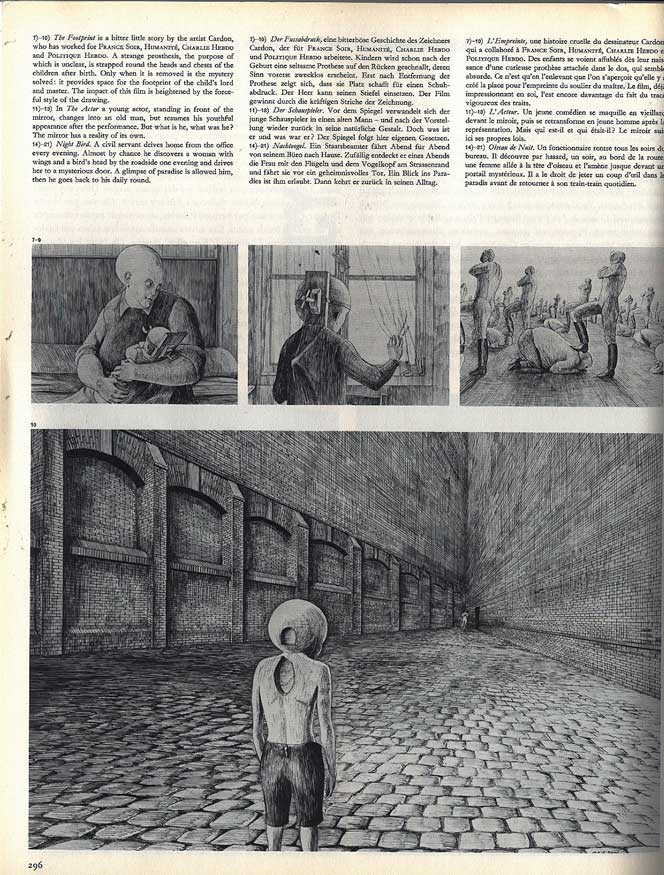
7-10.  "The Footprint" is a bitter little story by the artist Cardon who has worked for "France Soir", "Humanite", "Charlie Hebdo" and "Politique Hebdo".  A strange prosthesis, the purpose of which is unclear, is strapped round the heads and chest of the children after birth.  Only when it is removed is the mystery solved: it provides space for the footprint of the child's lord and master.  The impact of this film is heightened by the forceful style of the drawing.


11-13.  In "The Actor" (Jean-Francois Laguionie. Production: Les Studios du Languedoc, Clapiers) a young actor, standing in front of the mirror, changes into an old man, but resumes his youthful appearance after the performance.  But what is he, what was he?  The mirror has a reality of its own.

14-21. "Night Bird".  (Bernard Palacios. Production: Pink Splash Prod., Maison-Alfort)  A civil servant drives home from the office every evening.  Almost by chance he discovers a woman with wings and a bird's head by the roadside one evening and drives her to a mysterious door.  A glimpse of paradise is allowed to him, the he goes back to his daily round.

The jury considered the best complete programme to be that from the United States. Apart from the films illustrated here -"This is not a Museum", "The Cloudmaker", "WOW" and "Closed Mondays" -Gene Deitch showed his film version of Tomi Ungerer's "The Beast of Monsieur Racine" and Bob Kurtz an advertising TV spot for Levi's jeans in the style of the great painter of the West, Frederick Remington.

From Britain came "Bigger is Better", "Butterfly Ball" and "Amateurs Night".  "Cafe Bar" is by Alison de Vere, who once drew for Halas and Batchelor and supervised the settings for "The Yellow Submarine".  Her film has all the ingredients of the successful animated film: an imaginative story, surprising developments and ideas, colours, forms and gags.  The action take place on a lady's hat in a cafe.  "The Miracles of Flight" by Terry Gilliam is a plastic picture book.  It is all about the invention of a flying machine, but as the successful flight never comes off in the film, it has to be limited to the ceremonies taking place in the airport.

There were not many highlights from the Eastern Bloc, which used to hold centre stage a few years ago.  The old master Jiri Brdecka had a new opus to show: "The  Miner's Rose." His films are always among the best, as are those of Ion Popesco-Gopo, who this time presented "Intermezzo for an Eternal Love", a charming piece in which the earth adorns itself with man's productions.  There is admittedly a painful middle passage in which the decorations consists of ruins, fumes and smoking chimneys, but there are finally replaced by flowers, vines and butterflies.  "In the Grass" by the Pole Jerzy Kalina is made up  of movement, cut-out figures and materials. Fabulous creatures of the technical age, half birds, half aeroplanes,  demonstrate the struggle for survival in nature.  Branko Ranitovic wih his "Chameleon" reminds us of the great days of the animated film from Zagreb.  In a ten-minute speech before the UN he unmasks the inconstancy of the political demagogue.  Hungary contributed "Ca ira -Battle Song of the French Revolution" by Gyorgy Kovasznai.  The principal figures of the French Revolution are conjured up in bold brush-strokes to the stirring notes of the song.

Among other productions that caught the attention were an appealing film painted in lustrous colours by Caroline Leaf, "The Marriage of the Owl"; "Smile 1 and 2", done in coloured sand by the Swiss Ernest and Gisele Ansorge; the study "Perspectives" by their countryman Georges Schwizgebel; and Borislav Saktinac's amusing tale of the cat that conjures with mice, "We Are a Crowd."

The members of the jury were Mustapha Alassane, Nigeria; the Russian critic Sergei Assenin; Miroslaw Kijowicz of Poland; the grand old man of animated film, Len Lye; Kati Macskassy, daughter of the Hungarian film pioneer; Farshid Mesghali of Tehran; Jimmy Murakami; the acoustic specialist Pierre Schaeffer; Zdenek Smetana of Prague and the Italian critic Piero Zanotto.

CAPTIONS:

22-27. This is Not a Museum (John E. Haugse.  John E. Haugse, Santa Barbara). A man makes the acquaintance  of modern art in an unconventional museum.  The film is beautifully painted, in some cases directly on the film strip.  The sculpture in fig. 25 is borrowed from Magritte.

28-30. The Cloudmaker (Peter van Deusen.  Churchill Films, Los Angeles).  An allegory about our endeavors to live with technology.  A small figure, obsessed with the idea of making clouds, labours in vain with huge technical constructions.  Resigning at last, he goes on to manufacture -as a substitute -flying nuts and bolts.  The film, for all its charm, is much too long at over 16 minutes.  It almost seems as though a 15 minute limit would offer all-round advantages, for the phenomenon of the overly long film presented itself in almost every programme.


31-39.  Wow, Women of the World (Faith Hubley; Hubley Studio, New York). Made in honor of International Woman's Year, this film depicts the development of the relations between man and woman and attempts to open up a way to new understand between the sexes.


40-42. Da Da Da (Peter Hudecki: Sheridan College, Ontario).  A 95-second film, the first by this artist.

43-45. The Wild Man (Giuseppe Lagana: Corona Cinematografica, Roma).  writer of children's books makes skillful use of stylistic elements borrowed from Art Deco.  A bogey man steals a child and gets himself into no end of difficulties as a result.  The 11 minute film was made with movable, cut-out figures.


46-52. Amateurs Night (Thalma Goldman: Thalma Goldman, London).  Thalma Goldman, a young Israeli, studied animation in London for two years and now presents her third film.  On an "amateurs night", a number of amateurs do a strip-tease on the stage.  The film shows not only the performers themselves, but also the reactions of an enthusiastic audience that is really "with it."


53-54.  Butterfly Ball (Lee Mishkin: Halas & Batchelor, London).  In this children's film the frog invites all the animals in the wood to a big ball.  Lee Mishkin, veteran of "Popeye", "Magoo" and the "Pink Panther", deploys all his tricks in this bright mixture of Tiffany glass and Hollywood.

56-58. Bigger is Better (Derek Phillips: Derek Phillips, Hounslow).  Cut-out shapes and moving drawings are here used to depict the transition from the individual to mass society and the consequences it entails.


55. One (Paul & Gaetan Brizzi: Paul & Gaetan Brizzi, Paris).  This first film by two graduates of the Ecole des Arts Decoratifs in Paris was made possible by a grant of the Service des Arts Graphiques of the ORTF.  It tells the story of a last survivor of a civilization and the nightmarish creature that pursues him.

59.  The Miner's Rose (Jiri Brdecka: Kratky Film, Prague).  Twenty-five years on, still one of the best: Jiri Brdecka.  His 8-minute film is a miner who doesn't go back to his fiancee after the night shift.

60-61.  Closed Mondays (Will Vinton: Will Vinton & Bob Gardiner Prod, Washington).  Expressive plasticine figures are modified from frame to frame.  The hero happens to find his way into a museum on a Monday, which is closing day, and discovers that works or art live lives of their own.  Is it really only a step from the dream to reality?

Friday, July 16, 2010

Tune In Tonight

Our fifth piece for "Need to Know" airs tonight. PBS 8:30 (check local listings).

The show in its entirety will be available at: http://www.pbs.org/wnet/need-to-know/ by Saturday morning. At some point our segment will be up for individual linking.

We had a little more time than usual on this. We shot on Friday (one week ago). I didn't start editing until Monday -sending the 'radio edit' of the segment to the network by early afternoon with the picture to follow on Tuesday.
By Wednesday we had all the animation and the whole thing pretty much locked. Thursday bright and early Steve Brodner came into loop some dialogue which we didn't get down in the shoot (the first time we've done that on any of these films).

Friday night -on the air!

There was something kind of mellow and enjoyable about this one. On Monday we came up with a soundtrack- a kareoke version of Billy Joel's "Just the Way You Are." It was funny and appropriate but I kinda hate Billy Joel so on Thursday morning another track struck me- a 30s dance hall version of "Love For Sale". It's a toss up as to which is "better" so we delivered both.

That's one great thing about PBS, all music is fair use and free.

Thursday, July 15, 2010

Animator #89 - Disputes on the Rise

The issue of holiday pay is starting to blow up and Pal is locking out over non-union hires.

STATE OF THE UNION

DISNEYS: The company did come up with a new excuse and the two days pay, granted by award of the arbitrator and oked by the War Labor Board, has been held up again.  The company now claims that it will not pay the two days without permission of the Treasury Department to pay those earning over $5,000 as well.  The request went in we disagreed with the picture they gave that Department.  The Treasury informed us that we could only appear before them if given us its final answer as to whether or not it will appeal the decision of the Treasury.

We are if the opinion that the Treasury does not have jurisdiction on this matter and we are checking this.  As was stated in the full report made on this situation in the July 14 Animator there never was any question of our abiding by an arbitrator's award having once signed an agreement to do so.  We believe in, and have worked, and will continue to work for, decent labor relations.  (Walt Disney is one of the incorporators of the Motion Picture Alliance for the Preservation of American Ideals, incorporated August 29, 1944.  Get a copy of "THE TRUTH ABOUT HOLLYWOOD", put out by the twenty guilds and unions, from your steward or the office.)

SCREEN GEMS: The members received two days pay for Xmas and New Years the day before they closed down for their vacation.

WARNER BROS: Negotiations go to the Conciliation Dept. Friday.  Leon Schlesinger's representative mad the statement before the WLB that Mr. Schlesinger refused to arbitrate the question of Xmas and New Years and that he would not obey an order of the WLB.

LANTZ: We still have not heard from their attorney regarding our request for settlement or arbitration of Xmas and New Years.  Lantz reports he is out of town.

PLASTIC: Two meetings have been held on negotiations, others will follow.

PALS: We have asked for arbitration on 4 matters, to date we have not received from the company the name of the arbitrator.

Pals sent everyone home on Friday and locked us out.  Our members there were being asked to work with someone without a card or a work permit.  The Union gave them the names of 4 members qualified to do the work, in fact 2 have held the very job.  We even went further...


...and offered to let the man presently on the job finish the particular work he is doing.  We cannot allow a person without a work permit or without a card to work when regular members are able and willing to do the job.  There would be no point in our 6 months work permit period if we could not take the work permittees off and put a regular member on who is qualified to do the work.  As the membership knows we put in this 6 months ruling because 1) we felt the men in the armed forces should get at least that much protection and 2) it was not our desire to take initiation fees from people until they had been in the industry at least six months, so there might be some reason to believe that they are intending to remain.

The company, of course, could have let our people work, turn this man off and asked for arbitration to solve this, but they want us to allow him to work and arbitrate.  Any read of the above scene would show what we are up against in regard to the procedure, with Disney refusing to accept an arbitrators award, Schlesinger stating in advance that he would defy a WLB order and George Pal in violation of his contract by not even giving us the name of his arbitrator when we asked for arbitration in accordance with our contract with him.

INBETWEENS

WARNERS - Frank Tashlin now producer at Plastic Studios...  ....Warners have spent the last four weeks remodeling the cartoon studio and the work continues -returning vacationers were very pleased over the improvements... Bob MacKimson, new unit director ... Phil Monroe sports new Sgt. stripes

LANTZ - A bowling team has been organized and is to play in the Universal meet.

Then a list of winners from the golf tournament.  Disney was best represented (John Sibley, Ham Luske, etc) with MGM coming in second (Preston Blair).

Page three largely consists of an open letter to the country by a soldier stationed in New Guinea.

INBETWEENS about marriages and vacations.


Page four. Books for sale.

INBETWEENS include Bob Cannon one week overdue from vacation in Mexico and some updates on members in the military.

Wednesday, July 14, 2010

Modern Dance

In professional football, I can point out the successful strategies and executions that bring a team victory -not just in the game, but on a play by play basis.

A good percentage of American males can do the same thing.

This skill can be applied to all sorts of productions: baseball, animation, painting.  Once you have a grasp of the vernacular, every act of creation can be dissected and understood this way.

Dance has always seemed alien to me.  I tune out the ballets in Wagner and get lost watching any steps short of the Nicholas Brothers.


Art Spiegelman should be admired for his energetic pushing of limits, for his tenacity in conquering far off forms like opera and dance.

His "Hapless Hooligan in 'Still Moving'" is one of four pieces being performed by Pilobolus at the Joyce Theater through August 7.   It's an odd vaudeville, largely entertaining and the motion graphics are cute but wear thin.  They compare, unfavorably, to Kentridge's "The Nose" recently mounted at The Metropolitan Opera but still hold a degree of charm.

The piece plays with antique comic strip archetypes.  You've got the Blondie style waif, the cad beau out of Fontaine Fox.  Spiegelman has spent much of his career trying to convince us that comics are something other what the English speaking world wants them to be.  He transports the newsprint tropes -Krazy Kat brick and all -to the dance stage. 

The comic has a long history going to the stage.  Buster Brown at the turn into the 20th Century, L'il Abner at the half way mark, and the Addams Family today.  Amongst the dozens of other adaptations are the most produced musical in America ("You're a Good Man, Charlie Brown") and one of the most popular with budding 8 year old Sarah Brightmans ("Annie").

It's no surprise that Spiegelman, constantly recasting the comic as a high art form, would forgo the popular venue for a high end experimental dance troupe.  Sure, dance may be apples to musical theater's oranges -but the cultural tiering is worth note.

I may not be able to competently criticize dance (and every piece was well performed and enjoyable) but like a dutiful housewife who sees a "go" route connect for a 60 yard touchdown, I can tell a "home run" when I see one.


The final piece on the program -which includes an elegant piece of animation by the talented Peter Sluszka (who you may know from his Emmy Award winning animation on "I Spy"...) -is a "home run", or a "knock out" or some other inappropriate sports metaphor.  "Rushes" is dynamic, funny and moving.  You see this and you immediately understand why people love dance.

Tuesday, July 13, 2010

Marguerita

I picked up a 1975 issue of Graphis for the Roland Topor cover story and found two other notable articles inside.  In the future I'll post the magazine's wrap up of that year's Annecy festival.

For now, a piece written by Stanley Mason on a Marguerita Bornstein -well known at the time by simply  "Marguerita".


Being an international magazine, the editorial commentary is short. Just the top section of this page is the actual copy of the write up, it's then repeated in English and French.

The gist: Marguerita was born in Australia, raised in Brazil and returned to Australia where she became a household name in illustration and worked in animation.

A comparison is made to Tomi Ungerer -fair in one regard, unfair in another.  That's like measuring a left handed pitcher against Steve Carlton and his slider.


The top two frames are from an animated title sequence for "O Rebu" a Brazilian television series.

Much is made of 1950s animation design.  It's been recycled to intramural acclaim for the past couple decades.  I prefer the rawness of the 1970s stuff.


Above: frame from animated sequence from the Brazilian broadcast film "How To Make Your Child Schizophrenic".


The artist has been living and working in New York for some time but I'm unaware of any film work since this article.