Thursday, July 16, 2009

Track Reading

Every stage in drawn animation can rightfully be called the "most important". Following the procedure of the process is what makes a film work.

Following the procedure doesn't guarantee a "good" film, simply a competent one. How many "good" films are incompetent?

If each step is the "most important" track reading is clearly the most important too.

In the olden days here's what you'd do:

1) edit the soundtrack on tape
2) send tape to lab to get transferred to 35mm stripe magnetic film (putting the sound on a magnetic track opposed to an optical track). "Stripe" meant there was a stripe of mag down one side of the film. If the entire 35mm film was covered with this material it would be called "Full Coat".
3) wait a day
4) break down the audio frame by frame using manual rewinds and a "squawkbox".


Track reading is one element of drawn animation that hasn't been made significantly easier by digital technology.
We don't have to rely on labs to transfer audio, but the actual analysis is no simpler now than it used to be.

It can all be done in Final Cut Pro.
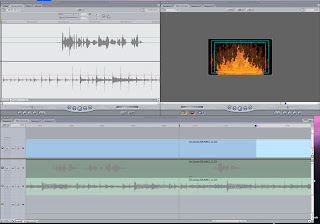

First things first.  You're doing drawn animation.  You do that 24 frames per second.  Make sure your project is set up that way.

If  your cut is at 29.97 (and that's perfectly legitimate and proper), you'll need to export your video at 24fps and reimport OR multiply all of your frame counts by .8 to translate them to the proper rate.

Set your timebase to "Frames".  This is done by right clicking (control+click) on the timecode number in the upper left hand of your timeline.  It defaults to timecode.  Animation happens in frames, not decimals of seconds.
Then, on the bottom left of the Timeline window make your tracks as large as possible (that's the four bars that look like cel phone reception).  Click the arrow directly to the right of that and select "show audio waveforms".   This will give you a visual read of the sound track.
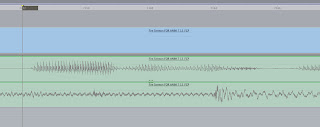

From here, it's just scrubbing through frame by frame and marking down what you hear on the exposure sheet.

The visual of the timeline makes it easy.

In this case the voice is on the upper track and the music on the bottom.

For lip sync -the vowels are important and will take up the most frames.  Find the vowels, mark their beginning and end then bracket them with the consonants.  Most consonant sounds will only take 1 or 2 frames.  "S" sounds are the general exception, obviously stylized reads may differ as well.

For music -mark the beats with "X".  If you've got instrumentation mark ins and outs of instruments or particular themes.  You can specify the nature of the sound to the extent its relevant to the action BUT the fact of the sound -that it is there is ALWAYS relevant to the animation.

exposure sheet detail
This film doesn't have lip sync.  Breaking down phonetics for 1:30 can take all day.  Here we have a phrase break down.  The beginning of a phrase is marked on the in frame, the end on the out frame.  If anything is sync sensitive that would be specified.  
Note the "X"s in the "track" column, which also contains the crash for "cymbals" and the mark that the cymbal is loud. 
The "action" column gives a general description of the scene.

Wednesday, July 15, 2009

Meow

The first project I did any substantial work on was "Troubles the Cat", thirteen 6:00 segments for The Children's Television Workshop series "Big Bag" which aired on Sunday mornings on Cartoon Network.

Children's Television Workshop is now "Sesame Workshop" and The Cartoon Network is in the throes its own identity crisis.

Troubles was a nice little show. Very warm.

The success, in my mind, stems from Santiago Cohen's designs.


We "cleaned up" the drawing some out of economy. Remember, this was painted on cel and shot on film. A looser style would take a lot more time and attention than a children's series allows.

Here are some of Santiago's paintings from around the same time.


Tuesday, July 14, 2009

Dig!, The Book - part three

Dig! is 25 minutes, at the point of production it was the Hubley's longest production for television (Of Stars and Men was nearly an hour, but produced for theaters).

That's why the book is so long. Here are another dozen pages.


The copy is pulled directly from the film's script.

The "echo" is difficult to produce in print. Effective in the film, poorly translated to the flat dimension.


Once again, the color treatment is impressive. Limited to black and a tone, the design makes wise use of color.


Here the main image is red with a touch of black. The character is colored in semi-tones. The lithostone would be prepared so that only a percentage of the color ink would transfer -giving tonal variation using a single ink and a single pass.

The mix of black and red can be striking.


And when it's "just" black, the reminder of color makes the graphic even stronger.


I can't recall the music from this film. The soundtracks to other Hubley films are indelible.

Even though each rock has a song, the melodies escape me.

Quincy Jones did the music. He's also responsible for the music in "Eggs" -possibly the finest music track of any Hubley short.


Any Hubley short with the exception of their Electric Company films.
Here are frames that seem pulled directly from the storyboard.


We see cartoonists do this today. Notably Chris Ware. Also Ivan Brunetti.

They'll create rhythmic, orderly frames for a page or more.

And ultimately break the order in a dynamic way.

This is treating the comic medium in a filmic way. Trying to control time.

Sunday, July 12, 2009

Why You Buggin?


Saw Jonny A for the first time in a while last night.

He's helped us out on a few projects over the years, mostly on art production. Some compositing -a few segments for "Curious", "Make 'Em Laugh" and sundry other things.

He's a big fan of Mary Worth and put this together:

Saturday, July 11, 2009

Get Those VCRs Ready

All About Prints makes its New York broadcast premiere on Channel 13 tomorrow. 1:00.

WLIW, Channel 21 will broadcast at 4:00.

We've been working hard on the DVD for a while. I'm not sure where you can order it, but if you'd like one email me and I'll see if we can make it happen.


The documentary encompasses history, technique and discussions with artists such as the great Will Barnet and Kiki Smith.


And some OK graphics too.


Friday, July 10, 2009

Goodnight, Harry Houdini

If I were better at birthdays and anniversaries, I would have noted a few months back- March 9, marked the 2oth anniversary of Fred Mogubgub's passing.

I think I was rehearsing the part of Bud Frump in our high school production of "How To Succeed in Business Without Really Trying" at that time.

Here's one of his paintings from 1983.

Goodnight Harry Houdini

It's unframed. I just hang the canvas. Although a frame would make it even more interesting.

He's already painted a trompe l'oeil frame. The foreground highlights and the sheen to the left hand side indicate a window and curtain. Already you're looking through two levels. Two levels of peeping into a bedroom. The paintings on the wall are a futhur pleasure- reminiscent of Seurat's painting of the woman in three poses featuring other Seurats in the background.

And, of course, the handcuffs on the table. Goodnight, Harry Houdini.