While trying to find "The Hat" yesterday, I found this instead:
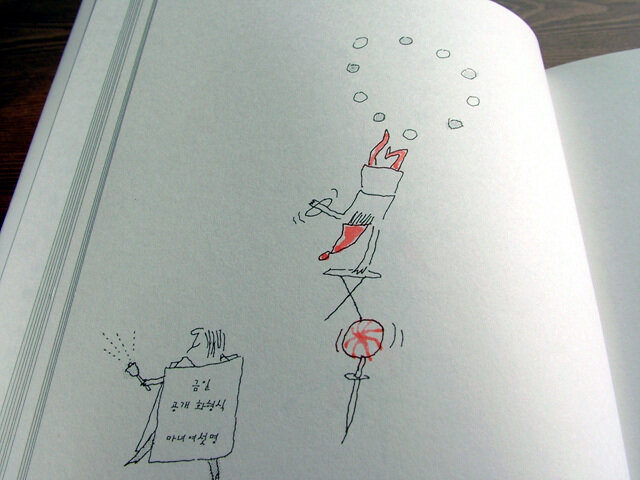
It's the first instance of R. O. Blechman's work being animated, predating Gene Deitch's "Juggler of Our Lady".
I had seen this Jazz film once before. Several years ago Bob telephoned Faith Hubley to see if she had a copy. I never met Faith- partly from social anxiety, partly because I don't care much for her work so I never sought her advice -she very kindly had a VHS copy of this dropped off.
I'm going to guess this was in 1999. It was the old editing room, before the remodeling in 2000/2001. Bob was mortified. It was worse than he remembered. He had to be convinced not to destroy the tape. That how he was, a perfectionist aesthete decades after the fact.
When this was made he was working at Hubley's Storyboard, Inc. drawing up boards for commercials. His tentative line was deemed unsuitable for animation, but Hubley liked his work and hired him. They'd take his drawings and make them "presentable". When this film came around, Bob said, they chose his illustration for the "dumbest product they could imagine" precisely because they felt it was so ill-suited to animation.
1) delivering a motion graphics project 2) getting started on drawn animation for documentary 3) illustration project with lots of seesawing 4) starting up video editing/website stuff for Jon Faddis
Faddis helped us out on the last of the Naked Campaigns for Sundance and "The New Yorker", his track makes the film.
He's a hard bopper and was a protege of Dizzy Gillespie (best known as a vocal contributor to John Hubley).
Here's a Faddis clip from several years back.
So I haven't had the time to put together a proper post for today, but it throwing this together I found a great one for tomorrow.
Who amongst us doesn't the lament the slow demise of the postal system?
Casting aside the hourly mail calls of Stoker's "Dracula" which birthed a whole new genre of the undead, taking the GPO's sponsorship of Len Lye out of consideration -the removal of tactile communication from human relationships is great loss.
Yes, LOLcats are nice. "Poking" is a fine form of saying "hello".
The letter, stroke for stroke, offers unparalleled potential .
Like Steinberg, only as much as they are part of an era.
These remind me of a story R. O. Blechman told me. In the 1950s he was friendly with Andy Warhol. They were both successful commercial illustrators and had similar circles.
Every couple of weeks Warhol would send out hand painted postcards to his peers. Bob would get one, read the back, and toss it into the trash.
Around the time he told me about this, a friend of his who had kept all the of the postcards (and gave Warhol his first polaroid camera) put his lot up for auction. I don't recall exactly how many zeros were in the sales figure, but it infinitely tops the value of even the most cherished email attachment.
I look through "Andy Warhol: Drawings 1942-1987" and couldn't find anything that definitely a postcard. I highly recommend this book for students of design and illustration.
Warhol represents many things, his cipher nature becoming the seminal figure of post-modernism, but one thing he clearly was: a clever and sensitive illustrator.
I think the art is very nice. It's loose pencil work, very expressive. It completely disregards "model" in favor of capturing the spirit. The backgrounds are crude water colors, but beautiful and effective.
There's a card that says this series was drawn and created by Chuck Jones. None of the drawings are signed, from the looks of the Bugs Bunny the Jones attribution seems accurate.
I'm greatly enjoying "Animation in the Cinema" by Ralph Stevenson.
It's like a snapshot of world animation taken from a British perspective in 1967.
Each chapter gives a cursory review of a nation or region's history and "scene." Although there are some academic deficiencies -claiming "Krazy Kat", for instance, as derivative of "Felix the Cat" when Herrimans' character pre-dates Sullivan's by several years -there are more than enough "I didn't know that" gems to make this a very valuable little book.
He lists four unproduced feature films developed by UPA: "The White Deer" based on James Thurber, "Don Quixote", Ben Jonson's "Volpone" (spelled with an "h"), and "Helen of Troy". This short list conjures the greatest "What if?" imaginable for animation history.
Stevenson has a cynical stance on American cartoon animation. He decries the violence of Tex Avery as cliché and the evolution of the Disney product as hackneyed. For my interests, this is fine. There's more than enough history dedicated to the Warner Bros. and Disney output. His treatment of independents, especially internationally, more than makes up for his distaste of the mainstream.
Here's an excerpt:
Chuck Jones in one of his films "Now Here This", instead of the usual sound effects shows a notice: GIGANTIC EXPLOSION. This is fine. But in the long run the violence palls, the formula becomes stereotyped, we tire of the endless repetition of virtually the same situation, the absence of any plot, any subtlety, and relief from the bang-bang-bang of two characters chasing and bashing each other.
He spends several pages on the American avant garde.
Oskar Fischinger: "Allegretto", "Composition in Blue", "Optical Poem", "An American March" as well as collaboration with the Disney Corporation on a sequence in "Fantasia".
Mary Ellen Bute: "Sychronization", "Anitra's Dance", "Evening Star", "Parabola", "Toccata And Fugue", "Tarantella", "Spook Sport".
John and James Whitney: only listing five short "Exercises" and "Yantra".
Yantra
Douglas Crockett (a name I didn't know): "Fantasmagoria", "The Chase", "Glenn Falls", "Sequence". These are oil paint on glass. Google is no help.
Hy Hirsh: "Divertissement Rococo", "Gyromorphosis"
Carmen D'Avino: "A Finnish Fable" and "Pianissimo" (following)
D'Avino went on to make several films for "The Electric Company".
Morton and Mildred Goldscholl: "Envelope Jive" and "Intergalactic Zoo". The Goldscholls had a commercial production company out of the MidWest.
Robert Breer (who is still active today): "Frame by Frame", "Four Phases", "The Miracle", "A Man and Dog out for Air", "Horse Over Tea Kettle", "Jamestown Baloos", "Blazes".
In case you've been missing it -like me. Because you've been working to "make ends meet"-like me. New York City has been hosting The World Science Festival 2009.
Last night I got to one event, Nothing: The Subtle Science of Emptiness. The festival also plays to the cheap seats with "Wall-E's World: Design for an Invisible Footprint" which mixes the pop science of carbon emission control with the feel-good theatrics of the Pixar film. Although no one involved with the film was scheduled to be at the forum.
Nothing. At the Tishman Auditorium. John Hockenberry did a great job moderating.
Most panels are poorly run, ones in the animation industry are no exception. Often it's one guy pontificating on his own work while the other panels look at their shoes, often it's silences and awkward pauses. Sometimes the moderator is over his head, sometimes he overpowers the guests.
Mr. Hockenberry showed a fluency with the difficult ideas with belittling them. He asked clear, provocative questions and kept all four scientists involved. He also did one thing that's rarely done (to my eternal frustation) he repeated audience members' questions, distilling their essence so everyone understood them.
So much for the wrapping. The content, the content was -nothing. A Nobel Laureate and three other really smart guys trying to pinpoint the content of nothing.
Even in a vaccuum there are pairs of particles and particles within particles.
I'm not much of an artist, so animation doesn't come easy to me. But I like to think about it. And animation is scientific. Things move in waves, everything moves in waves. And the most powerfully charged spaces, as in nature, are "empty".



 Norman McLaren to a friend
 communication


