Saturday, August 21, 2010

Great Fish

I was recently reminded of R. O. Blechman's "Book of Jonah".

Published in 1997 by Stewart Tabori and Chang as part of three book deal which included a reissue of "The Juggler of Our Lady" and the new title "The Life of Saint Nicholas", "Jonah" was sadly neglected.

In my opinion, it's not only Blechman's greatest work -it's amongst the top illustrated books of all time: comic books, graphic novels, or children's books.


You see his timing and perception of space in these few pages.


The images tell the story.  It's practically Ernie Bushmiller in it's graphic essence.  The words are punctuation.


The above sequence harkens back to "The Juggler of Our Lady".  The drawings here are better, of course, beyond that the progression of the images -full scale to single line evokes fear and abandonment better than 1000 words could. 

Timing, the space between the drawings, is finely tuned here.  The differences in Jonah's poses are weighted by the space around him and the progression through the pages.


At times the scale transforms and images devour entire spreads.

The color is as precise as the line is tenuous.  Tom Hachtman did the airbrushing on the original artwork.  R. O. is specific on the tones and application of the color.  Just like the line, it's deceptive simplicity belies a rewarding sophistication.


A book of beautiful images.


And solid storytelling.


And inventive graphic layouts.

Friday, August 20, 2010

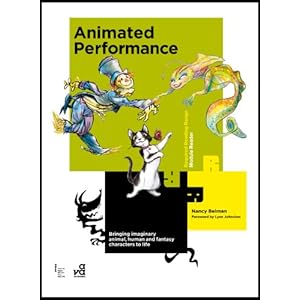
Book Report: Animated Performance

Every animator should write a book.

We'd have hundreds of perspectives on the process. Maybe a supercomputer could process them all and come up with the elusive answer to how it's done. I remember reading a similar thing was done to films resulting in the determination that Eastwood's "Unforgiven" was the best screenplay written.


Nancy Beiman's "Animated Performance" is a personal, professional and historical introduction to the animation process.

Unlike other books by animators (Richard Williams, Tony White, Eric Goldberg, Halas & Whittaker, Preston Blair) this one isn't overloaded with drawing by drawing exercises that show exactly how to draw a scene.


The book explains why before it shows you how. Along with Joseph Gilland's "Elemental Magic" this represents a pedagogic shift in animation instruction -a shift I find welcome. Interesting that both authors were staffers at Disney in the late 1990s. These two books make good companions.

"Animated Performance" doesn't sidetrack itself with too much on techniques outside the author's strength. She's a pencil animator, the book is about pencil animation with passing nods to other media. That's a great strength. Books that try to cover too much ground wind up apologizing for the conflation and doing justice to none.

In the tradition of Thomas & Johnson, Beiman relies on personal connections to films to illustrate points. Like them, she acknowledges the ideas of other artists. Interviews and anecdotes with other artists are woven throughout the book and there's no restraint in letting these artists speak for themselves.

It's top notch primer. In fact, I would recommend first time animation students begin with this text (and Miyazaki's "Starting Point") before proceeding to Tony White or Halas & Whittaker and then Williams. Right there you'd have a solid three year course of study.

Thursday, August 19, 2010

Here Comes Another

We've done a couple book promos, but nothing as good as this.


Martha Colburn made this for Simon and Schuster's "Here Comes Another Lesson" by Stephen O'Connor (no relation).

I like the music a lot. Nick de Witt is responsible for that.

As TV advertising dies and the reading experience merges more and more closely with the internet, it's a good sign that publishers are putting these types of ads out on the tubes.

Wednesday, August 18, 2010

Animation Notes 3/1/90 - Sports, Dance

Here are notes from Tissa David's lecture of 3/1/1990


Above: animating a bicycle

Above: animating an oarsman rowing

Above: Clouds.  Heaviest part of the mass can lead the transformation of the action.

Swimmer: utilize water
action under water


In a walk never have your character at a 90 degree angle.  Your character must lean otherwise he'll look rigid and stiff.

In a dance [illustration]

Animate dance straight ahead.  Have character always leaning.  Every action is like a string in a bow (the stretching and bending when your foot is stretched that is your hit  -accent).
Twisting and leaning  will make your dance more dynamic.
You must have music to get your beat.  Every fourth or eighth beat your character will dance.


Above: notes on horses and animated backgrounds

Tuesday, August 17, 2010

Saturday in the Park

Shot on Saturday for a "sketch" we're contracted to produce.


Above: me looking pudgy like Michael Moore.


Above: That's a racing trophy which Brian's father won standing in as The World Cup.  Irene Sherman lent us her children, Zack and Maya, for the morning.  They were great.


Zack's friend Jeremy helped out too.  He and his dad were a lot of fun to watch just throwing the ball around.

Monday, August 16, 2010

Big Throw

I'm an Eagles fan.

While I concede the negative connotations that go along with that -throwing snowballs at Santa, et cetera -I can also admit when another team (even the hated Giants) do something great.

This is something we're looking at for a project.  Eli Manning's improbable pass to David Tyree in the Super Bowl.


It's one camera shot (plus a close), and makes for a great dynamic scene.  An excellent storyboard study.

In the first panel we have the quarterback in a long shot, a crowd scene.    The Patriots defender crosses frame large in the second panel.  In panel three Manning escapes the crowd an drops back, giving a clear silhouette in the frame, this continues in panel 4.

Panel 5 is the ball in the air.

Panel 6 see the ball land in wide shot, in traffic.  We're not sure what happened as we zoom in to the scuffle.

The last three panels are another camera.  They could easily cut in after panel 6 for a continuous narrative action sequence.

This sequence, as true with most sports, follow the natural eye of the viewer.  It's how we track events.  Naturalistic storytelling benefits from utilizing the same patterns.

Sunday, August 15, 2010

More News - Animator Vol III #2

I guess we have a couple more Animator newsletters.

This is Volume III.  They're in much better shape and have significantly higher production value.


Page one features a touching remembrance penned by Chuck Jones in honor of Franklin Roosevelt.  Jones, of course, was an ardent FDR supporter and his tribute is personal and heartfelt.


Page two has a note opposed to the California Conference of Painters (AF of L) move to outlaw spray equipment by union painters and a letter to the editor from Chris Ishii.

STATE OF THE UNION

"We are waiting for the Disney decision which is due any day now.  A meeting of inkers and painters at Disneys is scheduled to discuss what to do with the incentive plan.

At Palls the panel of the War Labor Board is studying briefs and evidence prior to rendering their decision.  We are hoping for a substantial increase that will bring the rates in this studio up to somewhere near the levels paid elsewhere.

The Plastic dispute over wages has been referred to the War Labor Board for hearing.  At Graphic a contract has been negotiated that is satisfactory to the employees.  It provides for classifications and wage rates comparable to the other studios with the addition of a classification known as Technical Designer.

At Screen Gems, ten employees are up for wage increases on a Form 10.  The increases are for five and ten dollars weekly raises.

The Union has opened up the contract at all studios for the coming year.  The specific proposals will be presented later. Wages, earned vacations, cumulative sick leave and screen credit are some of the clauses we will open up for collective bargaining.


Page three

Headlines: A. C. T. Inaugurates Lecture Series
Service Ribbon
April Initiations
The Home Front

War Dept. Releases Lantz Short:
The War Dept. has released for mass public showing a cartoon produced by Waltz Lantz entitled "Two Way Street," explaining how lend lease operates.

The film, directed by Jim Culhane, will be shown at 14,000 movie houses.


Page 4

A few letters from members in the armed forces and a photo Air Corp Animation Unit.

Some names that pop out (I'm too young to remember faces): Norman McCabe, Jack Schnerk, Willis Pyle (who animated Blechman's Alka Seltzer Stomach), Major Rudolf Ising, Sgt Julius Engel, S/Sgt. John K. Hubley, Rudy Larriva, William T. Hurtz and Phil Monroe.


Page five reports a new production manager at Screen Gems.

Old Masters

Donald Duck as the old masters might have painted him (given a prominent spread in a recent issue of "Life") was a gag that just grew.  They were done in colored pencils to simulate oils and pastels.  The perpetrators and artists were John Dunn, Ray Patin, and Phil Klein.

[note to duck lovers: keep your eyes peeled for Life magazine from the first half of 1945.]

A sports column recounting inter-animator matches (Ken Harris downed Bob Gribbroek 6-2 6-2; Bill Justice dropped Ham Lusk 6-1 6-0).

Everyone is invited to attend the Girl's Softball games held at Disney's almost every noon.  (Boys, it is rumored that the girls are attired in those very brief playsuits).

Page six "inbetweens" gives a full accounting of gossip and goings on in the represented studios.