Tuesday, July 21, 2009

Trading Cards

Animators should have trading cards. Like baseball players or Pokey men.

This is a French Canadian card part of the "Cards of Mister Movies (illustrated story of the movie world" series.

John Hubley, rightfully, is represented.


Represented are "Cockaboody" and, inset, "Adventures of an *".


Here's my attempt at translation. Pardon moi, M. Raffa.


Born in 1914 to a family of painters in Madison, WI, Hubley naturally gravitated to the plastic arts. After attending the Art Center of Los Angeles, at the age 22 he began to work for Walt Disney Studios where he assumed important responsibilities: designer for certain sequences of "Snow White" [I guess that's what "Blanche-Neige" is]. He went on to be an art director on "Pinnochio", "Bambi", and "Fantasia".
The year 1941 marked serious changes at Disney. Hubley was one of a few -along with Frank Tashlin who was a director Screen Gems and Stephen Bosustow -to found "The United Productions of America", the famous UPA -which produced commercial work which ranged for a great freedom of expression. At a time when design was too realistic, they preferred the styles of Mattisse, of Miro, or the ease of Dufy. Instead of bunnies and deer, they preferred human characters -sometimes along the lines of Modigliani or Klee.

After making military instruction films for the US Navy and Air Force, Hubley briefly collaborated with Tashlin (who replaced Dave Fleischer) before creating UPA after the positive experience on the production. He went on to refashion the American cartoon in the modern style -after Picasso and Steinberg -but also due to economic realities which imposed a simpler animation and simpler drawing. He created "Mr. Magoo" in memory of a myopic uncle who played the banjo [I probably got that part wrong. ], before leaving UPA under the pressure of the McCarthyites.

In 1953 he founded his own New York studio, "Storyboard, Inc." with his wife Faith -née Elliot -who collaborated on his films. Separating art and commerce, Hubley is distinct for his spirit of exploration and graphic invention and his choice of themes appealing to an adult audience which contributed to the change from animation for children.

Two "Oscars" for "Moonbird" in 1960 and "The Hole" in 1963 and a long film evoking the many ages of men "Everybody Rides the Carousel" in 1975. His career was brutally interrupted at its height on February 21, 1977 during open heart surgery.

It then lists a filmography -no mention of "Scent of Old Whiff", but something called "Children of the Sun" from 1960 which I'm not familiar with.

Monday, July 20, 2009

The Damage Done


Came across this quote in an old notebook.

From the New York Times Magazine, August 18, 1968


"One of the most disastrous cultural influences ever to hit America was Walt Disney's Mickey Mouse, that idiot optimist who each week marched forth in Technicolor against a battalion of cats, invariably humiliating them with one clever trick after another.

I suppose the damage done to the American psyche by this foolish mouse will not be specified for another 50 years, but even now I place much of the blame for Vietnam on the bland attitudes sponsored by our cartoons."

James Michener


Sunday, July 19, 2009

Quick Kells

The stills, two or three that I had seen, were unappealing. Despite internet enthusiasm, I had no expectations for "The Secret of Kells."


No expectations is for the best.

Turns out the character design works well for animation, and the big blocky ugly hands are unobtrusive.


above: an animator's reel

A few scattered thoughts:

The animation itself is workmanlike, without much flourish. The design overpowers the picture.

The film owes a great debt Richard Williams -mostly in design. "The Thief and the Cobbler" predicts the ornate quality mixed with the tight retro-style line.

The crowd layout is particularly strong. Crowds of several monks move with a witty stylization.

It's a kids film, but contains very few throwaway gags we've seen in American children's films.

Saturday, July 18, 2009

Blueberry Scoop

We did some motion graphics for the documentary "The Mighty Humble Blueberry" which is now available on DVD.


Did you know blueberries weren't domesticated until 1911?

Were you aware that domestication happened in the Garden State itself?

Here's the trailer:


Signe Baumane also did some title card illustrations for the film making it even more cooler.

Friday, July 17, 2009

Old Armor

More R. O. Blechman rareness.

"The Emperor's New Armor" was made for Aspen 1969 Design Conference. Animation was by Al Kouzel.


I got the film on eBay several years ago. It's a Kodachrome stock and a little pink. At one time is was property of Pyramid Films, the legendary distributor.

This one is rare. Later, we'll post an even rarer Blechman short "The Emperor Visits".


The story is an anti-military parable. Some shysters convince the emperor he needs armor.

They sell him a spikey plate mail which destroys everything in its vicinity.

Naturally, the only remedy is to buy armor for everything else. The dining room furniture, the wife, the cat, the mice.


These are a couple shots off of the wall. Still working out the kinks on the projector.
His son returns, not wearing any armor. He runs to his father and is quickly crushed to death by its weight.

The ironic moral: In a world without armor, nothing is safe.

Thursday, July 16, 2009

Track Reading

Every stage in drawn animation can rightfully be called the "most important". Following the procedure of the process is what makes a film work.

Following the procedure doesn't guarantee a "good" film, simply a competent one. How many "good" films are incompetent?

If each step is the "most important" track reading is clearly the most important too.

In the olden days here's what you'd do:

1) edit the soundtrack on tape
2) send tape to lab to get transferred to 35mm stripe magnetic film (putting the sound on a magnetic track opposed to an optical track). "Stripe" meant there was a stripe of mag down one side of the film. If the entire 35mm film was covered with this material it would be called "Full Coat".
3) wait a day
4) break down the audio frame by frame using manual rewinds and a "squawkbox".


Track reading is one element of drawn animation that hasn't been made significantly easier by digital technology.
We don't have to rely on labs to transfer audio, but the actual analysis is no simpler now than it used to be.

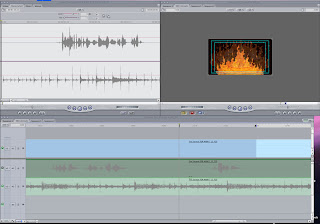
It can all be done in Final Cut Pro.


First things first.  You're doing drawn animation.  You do that 24 frames per second.  Make sure your project is set up that way.

If  your cut is at 29.97 (and that's perfectly legitimate and proper), you'll need to export your video at 24fps and reimport OR multiply all of your frame counts by .8 to translate them to the proper rate.

Set your timebase to "Frames".  This is done by right clicking (control+click) on the timecode number in the upper left hand of your timeline.  It defaults to timecode.  Animation happens in frames, not decimals of seconds.
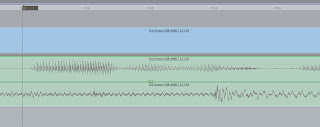
Then, on the bottom left of the Timeline window make your tracks as large as possible (that's the four bars that look like cel phone reception).  Click the arrow directly to the right of that and select "show audio waveforms".   This will give you a visual read of the sound track.


From here, it's just scrubbing through frame by frame and marking down what you hear on the exposure sheet.

The visual of the timeline makes it easy.

In this case the voice is on the upper track and the music on the bottom.

For lip sync -the vowels are important and will take up the most frames.  Find the vowels, mark their beginning and end then bracket them with the consonants.  Most consonant sounds will only take 1 or 2 frames.  "S" sounds are the general exception, obviously stylized reads may differ as well.

For music -mark the beats with "X".  If you've got instrumentation mark ins and outs of instruments or particular themes.  You can specify the nature of the sound to the extent its relevant to the action BUT the fact of the sound -that it is there is ALWAYS relevant to the animation.

exposure sheet detail
This film doesn't have lip sync.  Breaking down phonetics for 1:30 can take all day.  Here we have a phrase break down.  The beginning of a phrase is marked on the in frame, the end on the out frame.  If anything is sync sensitive that would be specified.  
Note the "X"s in the "track" column, which also contains the crash for "cymbals" and the mark that the cymbal is loud. 
The "action" column gives a general description of the scene.

Wednesday, July 15, 2009

Meow

The first project I did any substantial work on was "Troubles the Cat", thirteen 6:00 segments for The Children's Television Workshop series "Big Bag" which aired on Sunday mornings on Cartoon Network.

Children's Television Workshop is now "Sesame Workshop" and The Cartoon Network is in the throes its own identity crisis.

Troubles was a nice little show. Very warm.

The success, in my mind, stems from Santiago Cohen's designs.


We "cleaned up" the drawing some out of economy. Remember, this was painted on cel and shot on film. A looser style would take a lot more time and attention than a children's series allows.

Here are some of Santiago's paintings from around the same time.