Thursday, April 9, 2009

Soon for Sunday

Yesterday evening we shot a segment that is scheduled to air on CBS Sunday Morning this week.

Today we're cutting and animating.

It's a variation on our "Naked Campaign" series, this time we're adding an element- Brodner tosses around ideas with Gil Schwartz, former magazine editor now personality for the network.

These shoots usually go smoothly. This was a little more complicated (two cameras), but with less drawing on camera it was a lot faster.

Here's one "behind the scenes" moment, indicative of the way these clips come together.

Wednesday, April 8, 2009

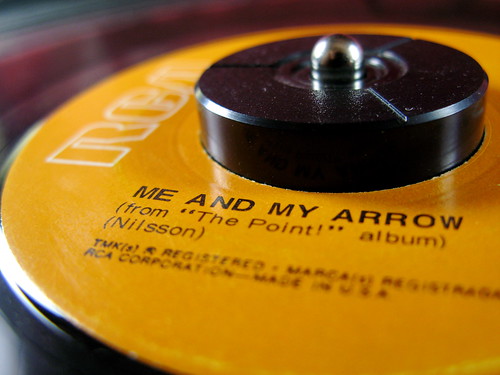
Me and My Arrow


During his long battle with cancer I gave my father two CDs, both sort of reflections on death. One was The Last Days of Wonder, the other Fox Confessor Brings the Flood.

Maybe that's why the only song on Neko Case's new album, Middle Cyclone, which has any appeal to me is the Nilsson cover, "Don't Forget Me" -a sad comedy, a fortune cookie.


Somewhere, there's an alternate animation history in which Nilsson's The Point is not forgotten. It's the first animated feature produced for television. Only one animator, Fred Wolf, is credited (with two additional animators).

The style is typical 1970s animation design -like so many Electric Company shorts. Nice enough, but I can't help but wonder what Hubley would've done with it.

Regardless, the music is what makes the film. The music and the "soul" of the picture.

While some consider the 70s a duldrum for animation; films like this, Heavy Traffic, Hubley's Carousel, Richard Williams' Christmas Carol suggest a path -or many paths -that the artform could take.


Tuesday, April 7, 2009

Mail Call

I have a scar on my left middle finger, caused by one  of these:

filmstrip projector

Third grade.  Some kid was plugging the projector into the outlet at the front of the room, pulling it forward. I noticed the chord was shorter than the distance from the desk to the wall.  As the device slid forward I ran to catch it.  I did.  Slicing my finger, putting the projector safely down and running straight to the nurse in one fluid act.

Today's mail brought in not one, but two, remembrances of this trauma.

"Change Your Underwear Twice A Week" by Danny Gregory and "Focus: The Collected Filmstrips of Brian Dewan".

"Change Your Underwear..." reproduces a few dozen "educational" filmstrips.  Some produced by animation outfits like The Jam Handy Organization (which produced live action and animated industrials and was the refuge of Max Fleischer after getting fired from his own studio by Paramount), others like "Protecting Our Eyes and Ears" produced by the weighty likes of the Popular Science Publishing Company, Inc.

These strips were still being used in Catholic schools in 1987, but I'm not sure how much longer they lasted.

I think they were pedagogically questionable, but culturally significant.  

Some kept the UPA graphic revolution alive in the eyes of 10 year olds decades after The Gerald McBoing Boing Show made its last broadcast.

Brian Dewan draws his own filmstrips and records the narrations in his own stentorian baritone.  His strip are serious to the point of absurdity: "Brand New Packages for Sale" and "The Habit of Innovation".

Not a filmstrip, but similar.  This is Brian narrating his illustrations to Leviticus Book 4 (while playing a Dewanatron) from a few years ago.  The quality is poor, but it's fun and gives you sense of the artwork.

Sunday, April 5, 2009

My Eyes Have Seen The Glory

Fred Mogubgub's "The Great Society"


Who couldn't use some Anancin?

Irony works best when its celebratory.

First Pitch


*****************

Back in the day, I said to our then-agent at The Ink Tank: "You want a hit TV show, I've got one word for you -Henderson."

So I called up Sam and we developed "Monroe!" from one of his earlier characters.

pitch book

The first place we went was FX. They bought the pitch for development in the room.

They didn't buy it for much, but any money to develop an idea is significant. At the very least it show the network is serious about your idea, at most it's a commitment to give the project its best chance of broadcast.


From this experience, I had assumed that pitching and selling projects would always be a breeze -walk in with a great idea, walk out with a check. Like hitting a grand slam in your first big league at bat.

This was more like a ground rule double -since we only got to develop a pilot script and storyboard, I guess it's more like an infield single.

the drawing is "crude" but highly effective

It was a long process to get the pilot board finished and by the time it got to point where we were ready to animate, the development people at FX had turned over and the new folks didn't pick up any of the existing slate for further development.

Based on his work here, though, Sam was able to get a gig writing for "Spongebob Squarepants" and live the sweet LA lifestyle for a few years.

Saturday, April 4, 2009

Back In Time

Art Bell's 2002 interview with Arnold Leibovit re-broadcast last week. It's online (subscription only).

The producer was appearing to push his re-make of "The Time Machine", but the majority of the hour was spent discussing George Pal.

Leibovit produced and directed the 1985 documentary "The Fantasy Film Worlds of George Pal" and 1987's "Puppetoon Movie" which is a compilation of Pal's earlier films hosted by Gumby.


More than any other branch of animation, Pal's type of stop motion is "magic". Objects take on life -shoes, clocks, and even the characters resemble toys.

The media is tactile. We relate to them as everyday objects. Our imaginations have already dreamt of our own toys coming to life.

The most inspiring part of Pal's imagination is his seamless leap from "Puppetoons" to "The Time Machine" -there is the mark of artistry.

Friday, April 3, 2009

Laying Down the Law


We've been talking to a megolithic corporation about a small job since the Bush Administration.

Recently they admitted they "didn't understand animation" and wanted to know "when they can change things". It would be self-destructive to point out: if you don't "understand" animation, what makes you think you have any grounds to make "changes", so we swallowed our fury and sent along this note, which is helpful to describe the process to potential collaborators who are new to the process.
*Start Note*

New technologies give us a lot of flexibility compared to ten years ago, but ultimately, animation is the same production process as it was for Daffy Duck or Popeye.

In this case, it’ll be closer to Astroboy or Star Blazers –but the idea is the same.


Here are the key steps to the process and what to look for at each point.

Script

Everything stems from this. Any jokes that need tweaking, or characters changed around, or locations altered –this is the place to do it.

There’s always some flexibility with this up until the voice record –which happens before animation begins –but once the track is laid down, any alteration to dialogue involves additional time for talent, audio facilities, voice direction, video edit, and depending on how far into production we are, animators, inbetweeners, trace and painters and compositors.

Character Designs

Character design is a bit like casting for type. The look of the character is defined. At this point we’ll work up several poses of each character.

Since this production is inspired by the classical anime form, that makes this phase much simpler. We know what the general style will be, so from here it’s a question of detail: hair style, clothes, color.

Once we go into production, any changes to design will lead to substantial work. Further, design revisions after this phase invariably compromise the final quality of the picture.

Storyboard

The storyboard will represent the final film in single frame, black and white drawings.

Here we look for narrative continuity, dynamics, general framing and camera position, shot sequencing and visual pacing.

Along with the storyboard, an “animatic” or “leica reel” is created. This is a simple edit of the single drawings against the voice track.

Animation

Traditionally, a drawn animation will have a “pencil test” which serves as a full, sort-of, rough cut. The pencil is line drawing of animation, often double-exposed onto a background. It shows the acting performance of an animated character.

Understanding a pencil test is a learned skill. Most people can’t look at one and make intelligent comments without examining the film for a prolonged period.

Pencil tests have come to be a luxury, as drawn animation is difficult to produce on 21st Century budgets.

Nevertheless, we do create motion tests throughout production. Considering the simple nature of this animation style, and the necessity to create much of this work digitally many of these motion tests will be in color.


At this point, it is sort of like a rough cut and “good” take in live action. Some acting changes can be made –along the lines of “is there a better read of that line?”. Different angles, additional shots, and other changes are the equivalent of calling a re-shoot in live action. It’s possible, but just like a re-shoot in live action, it requires a great expense of resources.

Rough Cut

By the time the rough cut comes around in animation all the creative decisions have been made. This is a point for fine tuning of edits/transitions/special effects.

What can be done at this point is the same as what you can do in a live action edit when there is no possibility of re-shooting.

*End note*