One week into the baseball season.
Last Monday, went down to Washington D.C. for the Phillies' first game.
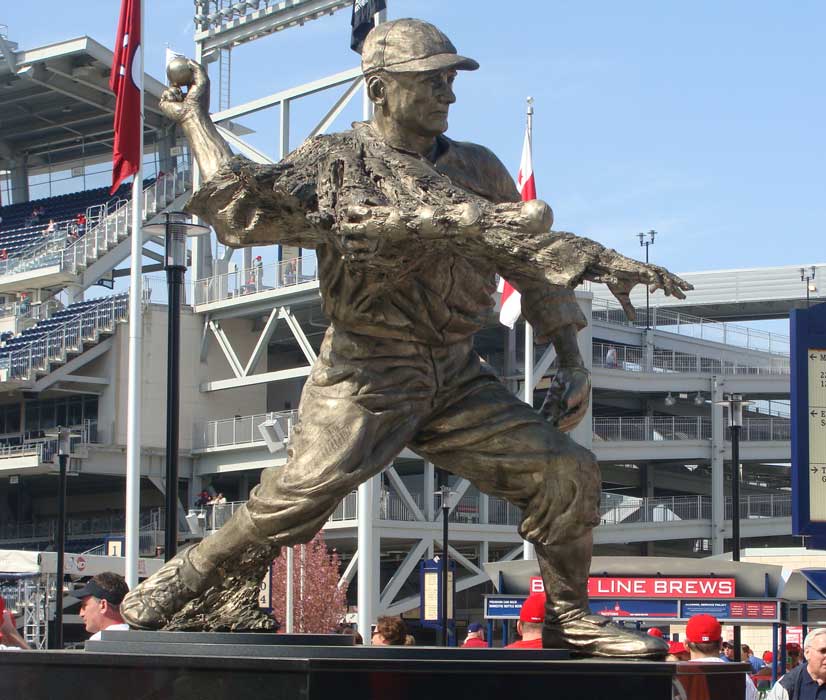
Most ballparks have statues of their team's legends. Nationals Park, bereft of legends, has a series of "Washington D.C." baseball heroes.
Sculpted by Omri Amrany, they attempt to capture motion in a still three dimension space.
Their initial impact is kind of monstrous.
Quickly, they become highly rewarding. Although the Nationals will be cursed as long as they keep Teddy Roosevelt from winning the President's race -the fans are at least rewarded with these statues to greet them.
Thursday, April 15, 2010
Wednesday, April 14, 2010
Shake It!
Here are notes for Tissa David's animation lecture of August 10, 1989.
Jump: down should have a bend to the body or he will bend break his leg.
Most camera shake movements are big and on 2's.
Exaggerate your stretch position. You will feel it 2 frames will not see that stretch drawing.
When you animate always keep your cut off field guide on your pegs (that way you'll know how much to draw.
Camera moves should be natural so you're not aware of them.
When animating a character out of field the legs should be animated even if they aren't in field.
Diving board example
Tuesday, April 13, 2010
We All Scream
Who doesn't love a delicious mouse shaped treat?
Even the folks at the Department of Justice, do!
DoJ Mouse should be the mascot for copyright reform.
Even the folks at the Department of Justice, do!
DoJ Mouse should be the mascot for copyright reform.
Monday, April 12, 2010
Daring Young Pancakes!
Here's another chapter from Harry Wayne McMahan's 1957 book "The Television Commercial". The first except is here.
This is a few pages on stop motion.
Following is the entire text. I'm not copying the text with images, you'll need to click on them to read.
STOP MOTION is probably the most ingenious technique, from a craftsman's standpoint, used in television commercials. Here is the way to make inanimate objects come to life!
The product can march, walk, dance and do tricks that seem to make it a living personality. Automobile doors can open close without the touch of a human hand. Mechanical gadgets can take themselves apart into a hundred pieces, show their precision innards, then put themselves back together -almost in the twinkling of an eye.
Lucky Strike is credited with creating the TV commercial interest in stop motion, back in 1949, with the popular "marching cigarette" commercials. The stop motion opening for Luckies' "Hit Parade" program soon became a classic of the industry and eventually established a record of six straight years on the air.
But, intriguing as the technique may be, Luckies did not rely on stop motion alone. Commercials in live action, with some cartoon, have consistently filled the major portion of their air time -for stop motion can rarely be expected to do the complete advertising job in TV commercials.
In this light, let us consider stop motion:
FRAME-BY-FRAME EXPOSURE
Like the cartoon, this technique of stop motion works on one frame of film -1/24th of a second -at a time. The product is set up and photographed for the first single frame, then moved to its next carefully planned position, photographed again, and so on. The result is that 24 successive single, when projected on the screen in one second's time, give the illusion of a definitely fluid movement.
Imagine the planning and skill involved in moving each of the cigarettes to each of the successive positions required. Sixty seconds is 1,440 single set-ups, 1,440 single photographs!
Scotch Brand Tape followed Lucky Strike with a top stop motion spot. Again a march was called for and the product marched into every room in the house. At this point in the commercials, live action inserts gave a believable demonstration of uses.
DARING YOUNG PANCAKES
Still more striking was the use of stop motion made by Pillsbury Pancake Mix. The copy theme was "Lighter pancakes are here!" and the visual selling was to be done by having the pancakes tossed in the air and light, very slowly, float over and down to the serving plate.
To accomplish this, pancakes were cooked over aluminum discs (to hold the shape, yet permit bending where the effect of motion required it); then, by a system of hidden armatures, the pancakes were suspended in mid-air step-by-step, photograph-by-photograph, as they traveled the slow arc from griddle to plate.
After the props were complete, the mechanics set up and the master plan prepared, it still required more than 16 camera hours to photograph this one :20 spot!
Pillsbury's "floating pancakes" is an example of creative imagination developing an advertising idea, "Lighter pancakes are here!" This film ran more than a hundred times on the Arthur Godfrey show.
ADVANTAGES OF THE TECHNIQUE
Stop motion has three advantages, the first shared with cartoon, the last shared with live action. Stop motion is best for:
Personalizing of the Product, such as the marching cigarettes. The product can be made to dance, fly, zoom or take itself apart and put itself together again.
Mechanical Action, such as fitting parts of a motor, or the addition of attachments to an appliance.
Demonstration, without human hands. The refrigerator can magically fill with shelf after shelf of foods. The doors of a range can mysteriously open and a luscious cake slide out.
Industrial films have long used stop motion to show mechanical action. Similar use for television commercials is more rare, simple because good selling is more concerned with consumer benefits than the mechanics of manufacture. Pillsbury's use is unusual in that it actually excited an emotional appeal.
Stop motion vies with cartoon in personalizing the product. In cartoon, it is the practice to "put a face" on the product. In stop motion, it is the practice to show the product exactly as it is.
FIRST, ASK TWO QUESTIONS
Stop motion vies with live action on demonstration and a careful decision needs to be made in the choice of technique. Ask yourself:
Which will demonstrate more effectively?
Which will sell more convincingly?
In other words, is it better to have that cake mysteriously slide out of the opened oven door or is it better to have a housewife actually take it out herself and hold it for her family -and the viewer to see and experience?
A decision on this point needs to be made. Generally it is solved by following up the interest-getting stop motion with a more natural, a more believable live action scene.
In the case of Kellogg's Sugar Corn Pops, the product excited opening interest with a Western dance in a miniature setting, followed by live action scenes of kids in Western atmosphere enjoying cereal.
Stop motion cost an average of $80 per foot when it is a single object doing fairly simple motion. More objects and more complex routines increase the cost, as in the case of Lucky Strike. Where special models must be constructed, as in the case of Pillsbury, additional charges are required.
Just remember never to get so intrigued with the fascinating mechanics of the stop motion technique that you forget to do your basic advertising job.
This is a few pages on stop motion.
Following is the entire text. I'm not copying the text with images, you'll need to click on them to read.
**********
STOP MOTION is probably the most ingenious technique, from a craftsman's standpoint, used in television commercials. Here is the way to make inanimate objects come to life!
The product can march, walk, dance and do tricks that seem to make it a living personality. Automobile doors can open close without the touch of a human hand. Mechanical gadgets can take themselves apart into a hundred pieces, show their precision innards, then put themselves back together -almost in the twinkling of an eye.
Lucky Strike is credited with creating the TV commercial interest in stop motion, back in 1949, with the popular "marching cigarette" commercials. The stop motion opening for Luckies' "Hit Parade" program soon became a classic of the industry and eventually established a record of six straight years on the air.
But, intriguing as the technique may be, Luckies did not rely on stop motion alone. Commercials in live action, with some cartoon, have consistently filled the major portion of their air time -for stop motion can rarely be expected to do the complete advertising job in TV commercials.
In this light, let us consider stop motion:
FRAME-BY-FRAME EXPOSURE
Like the cartoon, this technique of stop motion works on one frame of film -1/24th of a second -at a time. The product is set up and photographed for the first single frame, then moved to its next carefully planned position, photographed again, and so on. The result is that 24 successive single, when projected on the screen in one second's time, give the illusion of a definitely fluid movement.
Imagine the planning and skill involved in moving each of the cigarettes to each of the successive positions required. Sixty seconds is 1,440 single set-ups, 1,440 single photographs!
Scotch Brand Tape followed Lucky Strike with a top stop motion spot. Again a march was called for and the product marched into every room in the house. At this point in the commercials, live action inserts gave a believable demonstration of uses.
DARING YOUNG PANCAKES
Still more striking was the use of stop motion made by Pillsbury Pancake Mix. The copy theme was "Lighter pancakes are here!" and the visual selling was to be done by having the pancakes tossed in the air and light, very slowly, float over and down to the serving plate.
To accomplish this, pancakes were cooked over aluminum discs (to hold the shape, yet permit bending where the effect of motion required it); then, by a system of hidden armatures, the pancakes were suspended in mid-air step-by-step, photograph-by-photograph, as they traveled the slow arc from griddle to plate.
After the props were complete, the mechanics set up and the master plan prepared, it still required more than 16 camera hours to photograph this one :20 spot!
Pillsbury's "floating pancakes" is an example of creative imagination developing an advertising idea, "Lighter pancakes are here!" This film ran more than a hundred times on the Arthur Godfrey show.
ADVANTAGES OF THE TECHNIQUE
Stop motion has three advantages, the first shared with cartoon, the last shared with live action. Stop motion is best for:
Personalizing of the Product, such as the marching cigarettes. The product can be made to dance, fly, zoom or take itself apart and put itself together again.
Mechanical Action, such as fitting parts of a motor, or the addition of attachments to an appliance.
Demonstration, without human hands. The refrigerator can magically fill with shelf after shelf of foods. The doors of a range can mysteriously open and a luscious cake slide out.
Industrial films have long used stop motion to show mechanical action. Similar use for television commercials is more rare, simple because good selling is more concerned with consumer benefits than the mechanics of manufacture. Pillsbury's use is unusual in that it actually excited an emotional appeal.
Stop motion vies with cartoon in personalizing the product. In cartoon, it is the practice to "put a face" on the product. In stop motion, it is the practice to show the product exactly as it is.
FIRST, ASK TWO QUESTIONS
Stop motion vies with live action on demonstration and a careful decision needs to be made in the choice of technique. Ask yourself:
Which will demonstrate more effectively?
Which will sell more convincingly?
In other words, is it better to have that cake mysteriously slide out of the opened oven door or is it better to have a housewife actually take it out herself and hold it for her family -and the viewer to see and experience?
A decision on this point needs to be made. Generally it is solved by following up the interest-getting stop motion with a more natural, a more believable live action scene.
In the case of Kellogg's Sugar Corn Pops, the product excited opening interest with a Western dance in a miniature setting, followed by live action scenes of kids in Western atmosphere enjoying cereal.
Stop motion cost an average of $80 per foot when it is a single object doing fairly simple motion. More objects and more complex routines increase the cost, as in the case of Lucky Strike. Where special models must be constructed, as in the case of Pillsbury, additional charges are required.
Just remember never to get so intrigued with the fascinating mechanics of the stop motion technique that you forget to do your basic advertising job.
Val Sarra, of production company Sarra, Inc, is the primary name credited on these images. He's also listed with "stop motion expert" Bob Jenness in the first image of this post. Sarra was also a WPA poster artist.
Do's and Don'ts
******
Here are one of the spots this piece discusses:
Lucky Strike Cigarettes
Sunday, April 11, 2010
Declaration of Independence - Animator #76 4/14/44
My college, the Eugene Lang College of the New School for Research, prided itself on it's primary source policy. Intellectual inquiry began with documents of the day, not what later people had to say about them.
Maybe that's why I enjoy these Screen Cartoonist Guild newsletters from '40s. They're little time capsules.
In this issue, editor Karl Van Leuven takes the entirety of the publication to republish the Declaration of Independence. This was in response to "being deluged by propaganda which paraphrases or summarizes this core [belief], and then attempts to attach new concepts or meanings which are often in direct contradiction to our basic beliefs."
Imagine if Guild today came out to advocate reducing the world's nuclear arsenal.
Saturday, April 10, 2010
Another Day
Clearly we're doing something wrong to be so busy, yet so broke. Next time around, criminal activity (or maybe just politics) will be the way to go.
Thursday we had a shoot for project, yesterday we were the shoot for someone else's project. A New York based producer for Saudi TV KSA2 did a little profile on the studio.
She was interested in animation's relationship to art -something I can discuss at length, being pithy for a 2:00 profile is another matter.
We did show off some of our work for Infor to demonstrate process. These are animation drawings (clean ups) by Christina for one of the pieces.
Friday, April 9, 2010
Bang, Bang
Shoot yesterday. Bang!
We've been asked to put together an industrial piece in a little over a week. Bang! Bang!
There must be some bizarre Bat Symbol above our studio that alerts potential clients of our unreasonable love of unreasonable schedules.
It's a mixed spot, live action and animation -all from one camera angle.
Brian confers with the agency Creative Director and the live action director.
My attention was on more important things.
Sometimes we hypnotize clients if they get unruly.
And convince them to find an inner peace.
Project finishes next week. We won't be able to post the final (union rules), but maybe some tests and process stuff.
Subscribe to:
Posts (Atom)


