Friday, July 31, 2009

Pac Man Invasion - Part Two

Here's part two of three of this essay from 2002.

I should also thank Chris Robinson for publishing it.  I should also admonish him for not telling me how poorly written it is.

********

In 1876 the Technological Art School opened in Japan. Italian instructors taught European technique. Portraiture an realism crept into the national style, but the islands' artwork remained strongly lyrical. Watercolor remained prominent, subject matter continued to reflect nature -ponds, birds, trees, the harvest. "Astroboy", the atomic robot, like his reptile cousin, Godzilla, can never be part of this world. An impassible was erected in 1945.


A deep strain of pessimism has grown prominent in anime culture since the 1960s. Mirroring the exponential violence of Hollywood sequels, many series are typified by an explosive nihilism. The 1970s brought future classics of destruction like "Mobile Suit Gundam" and "Star Blazers". Series began to display an ultra-violence designed primarily to appeal to the active juvenile destructive impulses of teenaged boys. [EDIT: phew! <--- What a rotten sentence.]

Home video games -also produced overwhelmingly out of Japan -are closely tied to the giant killer robot brand of anime. The bos at AnimeNext crow the game tables. Girls wander the whole sales floor, giving each vendor a piece of time. The game table, the medieval wands, the earrings, the books, the DVDs all appeal equeally. Take off a girl's cat ears and replace her laser gun with a cel phone and she might as well be in the shopping mall.

Television programmers have a rule; boys will only watch boy shows, but girls will watch shows for girls and boys. So American broadcasters make boys' shows. This rule doesn't apply. Some titles are strictly girl territory. "Sailor Moon's" audience is mostly, but not exclusively, girls. "Sailor Moon" is a starter drug. A girl's first costume is usually a Sailor Jupiter or Venus or Saturn. They move up to the robot in a teddy with cat ears from "Chobits". Hollywood studios would consider a show like "Chobits" (a sort of "I Dream of Jeannie" with a robot and a teenager) strictly female material. In reality, its popularity crosses gender lines. The premises behind there shows generally involve girls with special powers who are secretly in love with and secretly loved by awkward yet beautiful boys.

The only gender indentifiable hero that a young girl from Kansas sees on television is "Buffy the Vampire Slayer". Buffy never reaches the depth of gloom in the typical anime. A standard show like "Bubblegum Crisis 2040" pits four women in killer bodysuits against a power grabbing corporation with an army of robot monsters. The women are mercenary and the bad guys often come out on top. "Bubblegum Crisis" is just one entry in a long catalog of powerful female heros. It may not be the most
popular show. It may not even broadcast in the United States, but there are plenty of homemade costumes of its heroines.


"Neon Genesis Evangelion", a popular title, is set following a planet wide catastrophe when the remaining humans are under attack from space aliens called "Angels". Humanity's only defense is a group of children who symbiotically fuse with machines to fight off the attackers. The hero is a boy, but the stars of the show and the most popular characters are girls. Earth's survival relies on the whims of teen melodrama and the dynamics of these kids. Not the cartoonish stupidities of television angst -which girl will Zack take the dance and will Screetch ever grow up? - the children of "Neon Genesis Evangelion" are bred to destroy. They battle their own emotional dysfunction. One film opens with the hero masturbating by the hospital bed of his rival and secret crush. The adults, mostly scientists, are manipulative, impotent figures who send the children on suicide missions while remaining safely harbored in an impenetrable fortress. The hero is eventually called on to kill the only being who ever expressed affection toward him. A Victorian melodrama played by Japanese cartoons: "Each man must kill the thing he loves..."


...TO BE CONTINUED...

Thursday, July 30, 2009

Pac Man Invasion - Part One

Photos from the just passed Comicon remind me of a piece I wrote in ASIFA International Magazine a few years back.

This is the first part. It's longer than I remember. Come back tomorrow for part II. The second part is better.

The PacMan Invasion

Two things about anime I know. One: Totoro goes around in a giant cat bus. Two: the girl who does Bulbasaur's voice is a real sweetheart. I know even less about Secaucus, NJ. Had "Return of the Secaucus Seven" anything to do with The Garden State I might have some insight into the town. My friend, cartoonist and writer Abby Denson, much closer to an expert, was invited to speak at AnimeNext, a modest anime convention in the local hotel. We planned to take the (non-cat) bus from Port Authority to the Crown Plaza Meadowlands fro the afternoon then back to New York for an R. Crumb opening in Chelsea. A few bus rides, a few hours in a hotel with costumed teens, and an evening in a crowded Manhattan art gallery.


Four others waited at Port Authority. A Haitian nurse, a geriatric in a hat, and George -16 or so and fastened to his mobile phone -with his lithe 5'9 girlfriend. The last two were also heading to the convention. George called in sick to work morning, his boss was insisting on a doctor's note the next day.

George's girlfriend wore a one-piece yellow mini and three and a half inch heels (under the natural 5'9). Arriving at the hotel she pulled homemade nunchucku from her bag -in one simple step her go-go outfit transformed into a kung-fu heroine. She may not have turned a head on Seventh Avenue, but in downtown Secaucus she'd cause a heck of a stir. Here, in the Crowne Plaza, she was amongst her own -pink haired fairies, blue haired fairies, women warriers. Anime, or more precisely the otaku fan culture, is happy Halloween.

It's coincidence that the rise of anime in America has mirrored the demise of trick-or-treating. Otaku are Halloween's lost generation. John Carpenter and fear of razor blades scared parents into keeping kids at home every October 31st. After decades of make up and mom's tailoring, dressing up became peripheral to the holiday; Halloween's real attraction was the candy -a microcosmic manifestion of conspicuous consumption. For many anime fans, the films are the candy. The main attraction is the look.

Anime's attraction amongst teens is part of a bigger trend. The United States is riding the crest of a wave of cultural infulitration on par with the British Invasion of the 1960s. The Japanese Invasion began in the 1980s, Pac Man was its Paul McCartney. Power Rangers, Pokemon, and Nintendo have had as much impact on youth culture of the early 21st Century as the mods and rockers from Liverpool had on the "Summer of Love". The economics of the Japanese Invasion dwarf all the skiffle records and Carnaby Street suits sold in the last fifty years.


Manga and anime were born during the American occupation of Japan after the Second World War. The tell tale big eyes are far from intrinsic to Japanese art. The traditional style is still found on the walls of sushi restuarants, eggplant shaped heads and slits for eyes. The current style reflects American popular art preceding the War -Felix the Cat and Mickey Mouse. Anime is the cinematic cousin of the Toyota. It's an Asian interpretation of American innovation.

"Astroboy" is the Adam of contemporary Japanese culture, born to Osamu Tezuka as "Tetsuwan Atom" in a 1951 manga (Japanese for "comic book"). His birth name, tellingly, literally translates as "Atom Boy". Atom Boy -the mid-century grandson of Fat Man, Little Boy and Betty Boop. Tezuka's hero is a prophet, preaching the love of life and the suspicious against science. In Astroboy's mythology he is a robot created by a doctor so obsessed with the creation of life he allows his own child to be killed. Astroboy is his mechanical replacement. Japanese animation will replay these themes for the rest of the millenium. American animation continues to focus on star crossed lovers and teaming up motley crews to fight the bad guys. Anime reflects on a child's alienation from life, especially adults, in a mechanical society.


...TO BE CONTINUED...

Wednesday, July 29, 2009

Hot Shots

After yesterday's post Matthew Messinger sent this great link to a DMB&B (the renowned advertising agency) archive at Duke University.

I haven't found the Mogubgub Life Savers commercial on there, but there are plenty of other Beech-Nut brand ads from the 1950s and late 60s along with many other ads -animated and live.


One series includes a skiffle act promoting the now defunct "Hot Shot Candies".


You can subscribe and download via iTunes.

Tuesday, July 28, 2009

Life Savers

Here is some artwork from a mid-60s commercial for Life Savers produced by Fred Mogubgub.


It's ink and marker on paper -not acetate. The paper is excellent, since the markers haven't bled much. There's very little bleed on the back.

There's also very little concern for title safety.

At some point Acme pegs took over from the Oxberry pegging. These are Oxberry. The distance between the pegs is the same, but the shape of the outside holes is different.

I wonder what precipitated this change. Is it only New York. Disney used a third system, like Acme, but three pegs span 7 inches opposed to 8 inches.

What's wrong with this picture?

Only the middle woman is numbered. I haven't seen the commercial, but from this art I imagine it was mostly quick cuts in the style of "Enter Hamlet". The woman in the middle probably animated -that why she's numbered. The rest may have been held drawings.


Monday, July 27, 2009

In the YYZ

Weekend in Toronto/Guelph happened to include a 35mm screening of "Fantastic Planet".


The reels were out of order, a problem you won't find on DVD -but the color and image detail are, uh, fantastic.

I've previously written a little about the film. Storywise, it's similar to sci-fi of its era -Planet of the Apes, Logan's Run, Soylent Green, The Omega Man -containing their intrinsic faults in addition to its own extraordinary merits.

This time, probably because of the projection (Facets, the distributor, had labelled the reels incorrectly) the excellence of the soundtrack was particularly apparent. The sound is strongly influenced by the early 70s electric Jazz. Bitches Brew, Big Fun, Nefertiti, etc.

Turns out the screening was put together by Nick Fox-Gieg.

He took us to late night Chinese food afterwards. The theater also had a postcard tacked up from Martha Colburn.


Sunday, July 26, 2009

Dig!, The Book - part four

More Dig!

The film is often called a documentary, and it was called that at the time.

It was made prior to Errol Morris and long before Michael Moore, when "documentary" was synonymous with "educational".

As an educational film, it's a logical progression from Bell Labs' famous Capra-produced films. Those utilized the popular aesthetic of their time to convey information to children. Likewise, "Dig!" took contemporary styles and made geological hay.

The sinewous texture in the drawing feels like a visual progression for Hubley as well. It predicts the look of "Eggs" (which was greatly influenced by the animator Tissa David) and makes a kind of visual bridge to "Windy Day".


Speaking of Tissa, this rock may have been that self-portrait she mentioned.

Tissa told me once that you can always trust a person with a strong nose.

This goes counter to popular (largely anti-Semitic, no doubt) belief. She became much more comfortable with me, she said, when she met my girlfriend -I had good taste in noses. Europeans.


In any event, the genre of documentary has changed radically in the past 20 years. "Dig!" might well fit into that classic definition, but I think that definition is useless. It co-mingles "Our Mr. Sun" with "Gates of Heaven" -those film share very little common ground.

The science film continues to be a vibrant format (as does documentary), but they're two branches of the "non-fiction" tree. First cousins maybe.

This selection from the "Dig!" book ends with a spread. These are fossils -which we all know are phoney and put there by God to test our faith.


Saturday, July 25, 2009

Penguins Can't Play Candyland

Our neighbors do speech therapy for kids.

They've decorated the hallway with some art.

It's not that I'm a lazy "blogger" or have run out of ideas on animation (that happened months ago), I'm posting these because everyone in the studio really enjoys them. We spent several minutes interpreting each -with hilarious results.

Maybe that helps give readers the mood of how things work around here.

Friday, July 24, 2009

Stars and Stripes Forever and Ever

Ed Smith entrusted me with a bunch of his papers, including a few union newsletters he edited in the 1960s.

The September 1964 newsletter has a page featuring Stars And Stripes Forever, a big commercial in its day.


The studio was then "engaged in producing a feature film, 'Howie'". "Howie", as far as I can tell, was never produced. There must be hundreds of films melting away in Fresh Kills that have their own unique stories to tell.

Thursday, July 23, 2009

Mobile Animation

At some point in the past decade I picked up "Christopher Hart's Portable Animation Studio".


It's not simply three blank flipbooks and an HB pencil. It mostly is.

The 50 page booklet turns out to be a decent little primer (for a grade school kid with a drawing habit). The artwork is the typical unattractive "cartoon" style, but a 12 year old could do worse.

And I just wanted to post a funny picture of Murray the Cat.

Tuesday, July 21, 2009

Street People


Long gone; "Boiler Man Dude" the scrawled Bart Simpson on an auto garage at 1st Street and First Avenue. Notable for it -against all probability -slight resemblance to the FOX TV star and signature speech balloon "Boiler Man Dude."

Cartoons are on walls across the city, across the country.
These are on the Lower East Side, location: classified to protect them from the copyright police.

Let it be known that your tax dollars have subsidized this.


Subsidized bookkeepers and do-gooders, most likely. Here's hoping there were no animators involved.

Jingoistic Big Bird was relegated to the far end of the mural, lest s/he continually ask for niggling revisions and hog up all the painters' time making the low budget project a financial black hole.


They captured the despair which many associate with "Peanuts". Perfect for a playground. Leave your false hopes on Essex Street, kids.

How could Tweety Bird be any more ballz? 1) put her next to a smug Garfield. 2) shades

In the distance Bugs Bunny tickles him some Elmo.

Trading Cards

Animators should have trading cards. Like baseball players or Pokey men.

This is a French Canadian card part of the "Cards of Mister Movies (illustrated story of the movie world" series.

John Hubley, rightfully, is represented.


Represented are "Cockaboody" and, inset, "Adventures of an *".


Here's my attempt at translation. Pardon moi, M. Raffa.


Born in 1914 to a family of painters in Madison, WI, Hubley naturally gravitated to the plastic arts. After attending the Art Center of Los Angeles, at the age 22 he began to work for Walt Disney Studios where he assumed important responsibilities: designer for certain sequences of "Snow White" [I guess that's what "Blanche-Neige" is]. He went on to be an art director on "Pinnochio", "Bambi", and "Fantasia".
The year 1941 marked serious changes at Disney. Hubley was one of a few -along with Frank Tashlin who was a director Screen Gems and Stephen Bosustow -to found "The United Productions of America", the famous UPA -which produced commercial work which ranged for a great freedom of expression. At a time when design was too realistic, they preferred the styles of Mattisse, of Miro, or the ease of Dufy. Instead of bunnies and deer, they preferred human characters -sometimes along the lines of Modigliani or Klee.

After making military instruction films for the US Navy and Air Force, Hubley briefly collaborated with Tashlin (who replaced Dave Fleischer) before creating UPA after the positive experience on the production. He went on to refashion the American cartoon in the modern style -after Picasso and Steinberg -but also due to economic realities which imposed a simpler animation and simpler drawing. He created "Mr. Magoo" in memory of a myopic uncle who played the banjo [I probably got that part wrong. ], before leaving UPA under the pressure of the McCarthyites.

In 1953 he founded his own New York studio, "Storyboard, Inc." with his wife Faith -née Elliot -who collaborated on his films. Separating art and commerce, Hubley is distinct for his spirit of exploration and graphic invention and his choice of themes appealing to an adult audience which contributed to the change from animation for children.

Two "Oscars" for "Moonbird" in 1960 and "The Hole" in 1963 and a long film evoking the many ages of men "Everybody Rides the Carousel" in 1975. His career was brutally interrupted at its height on February 21, 1977 during open heart surgery.

It then lists a filmography -no mention of "Scent of Old Whiff", but something called "Children of the Sun" from 1960 which I'm not familiar with.

Monday, July 20, 2009

The Damage Done


Came across this quote in an old notebook.

From the New York Times Magazine, August 18, 1968


"One of the most disastrous cultural influences ever to hit America was Walt Disney's Mickey Mouse, that idiot optimist who each week marched forth in Technicolor against a battalion of cats, invariably humiliating them with one clever trick after another.

I suppose the damage done to the American psyche by this foolish mouse will not be specified for another 50 years, but even now I place much of the blame for Vietnam on the bland attitudes sponsored by our cartoons."

James Michener


Sunday, July 19, 2009

Quick Kells

The stills, two or three that I had seen, were unappealing. Despite internet enthusiasm, I had no expectations for "The Secret of Kells."


No expectations is for the best.

Turns out the character design works well for animation, and the big blocky ugly hands are unobtrusive.


above: an animator's reel

A few scattered thoughts:

The animation itself is workmanlike, without much flourish. The design overpowers the picture.

The film owes a great debt Richard Williams -mostly in design. "The Thief and the Cobbler" predicts the ornate quality mixed with the tight retro-style line.

The crowd layout is particularly strong. Crowds of several monks move with a witty stylization.

It's a kids film, but contains very few throwaway gags we've seen in American children's films.

Saturday, July 18, 2009

Blueberry Scoop

We did some motion graphics for the documentary "The Mighty Humble Blueberry" which is now available on DVD.


Did you know blueberries weren't domesticated until 1911?

Were you aware that domestication happened in the Garden State itself?

Here's the trailer:


Signe Baumane also did some title card illustrations for the film making it even more cooler.

Friday, July 17, 2009

Old Armor

More R. O. Blechman rareness.

"The Emperor's New Armor" was made for Aspen 1969 Design Conference. Animation was by Al Kouzel.


I got the film on eBay several years ago. It's a Kodachrome stock and a little pink. At one time is was property of Pyramid Films, the legendary distributor.

This one is rare. Later, we'll post an even rarer Blechman short "The Emperor Visits".


The story is an anti-military parable. Some shysters convince the emperor he needs armor.

They sell him a spikey plate mail which destroys everything in its vicinity.

Naturally, the only remedy is to buy armor for everything else. The dining room furniture, the wife, the cat, the mice.


These are a couple shots off of the wall. Still working out the kinks on the projector.
His son returns, not wearing any armor. He runs to his father and is quickly crushed to death by its weight.

The ironic moral: In a world without armor, nothing is safe.

Thursday, July 16, 2009

Track Reading

Every stage in drawn animation can rightfully be called the "most important". Following the procedure of the process is what makes a film work.

Following the procedure doesn't guarantee a "good" film, simply a competent one. How many "good" films are incompetent?

If each step is the "most important" track reading is clearly the most important too.

In the olden days here's what you'd do:

1) edit the soundtrack on tape
2) send tape to lab to get transferred to 35mm stripe magnetic film (putting the sound on a magnetic track opposed to an optical track). "Stripe" meant there was a stripe of mag down one side of the film. If the entire 35mm film was covered with this material it would be called "Full Coat".
3) wait a day
4) break down the audio frame by frame using manual rewinds and a "squawkbox".


Track reading is one element of drawn animation that hasn't been made significantly easier by digital technology.
We don't have to rely on labs to transfer audio, but the actual analysis is no simpler now than it used to be.

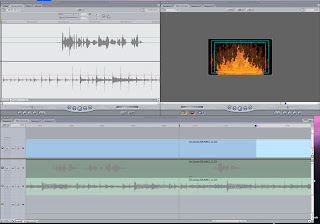
It can all be done in Final Cut Pro.


First things first.  You're doing drawn animation.  You do that 24 frames per second.  Make sure your project is set up that way.

If  your cut is at 29.97 (and that's perfectly legitimate and proper), you'll need to export your video at 24fps and reimport OR multiply all of your frame counts by .8 to translate them to the proper rate.

Set your timebase to "Frames".  This is done by right clicking (control+click) on the timecode number in the upper left hand of your timeline.  It defaults to timecode.  Animation happens in frames, not decimals of seconds.
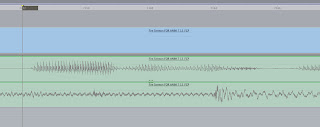
Then, on the bottom left of the Timeline window make your tracks as large as possible (that's the four bars that look like cel phone reception).  Click the arrow directly to the right of that and select "show audio waveforms".   This will give you a visual read of the sound track.


From here, it's just scrubbing through frame by frame and marking down what you hear on the exposure sheet.

The visual of the timeline makes it easy.

In this case the voice is on the upper track and the music on the bottom.

For lip sync -the vowels are important and will take up the most frames.  Find the vowels, mark their beginning and end then bracket them with the consonants.  Most consonant sounds will only take 1 or 2 frames.  "S" sounds are the general exception, obviously stylized reads may differ as well.

For music -mark the beats with "X".  If you've got instrumentation mark ins and outs of instruments or particular themes.  You can specify the nature of the sound to the extent its relevant to the action BUT the fact of the sound -that it is there is ALWAYS relevant to the animation.

exposure sheet detail
This film doesn't have lip sync.  Breaking down phonetics for 1:30 can take all day.  Here we have a phrase break down.  The beginning of a phrase is marked on the in frame, the end on the out frame.  If anything is sync sensitive that would be specified.  
Note the "X"s in the "track" column, which also contains the crash for "cymbals" and the mark that the cymbal is loud. 
The "action" column gives a general description of the scene.

Wednesday, July 15, 2009

Meow

The first project I did any substantial work on was "Troubles the Cat", thirteen 6:00 segments for The Children's Television Workshop series "Big Bag" which aired on Sunday mornings on Cartoon Network.

Children's Television Workshop is now "Sesame Workshop" and The Cartoon Network is in the throes its own identity crisis.

Troubles was a nice little show. Very warm.

The success, in my mind, stems from Santiago Cohen's designs.


We "cleaned up" the drawing some out of economy. Remember, this was painted on cel and shot on film. A looser style would take a lot more time and attention than a children's series allows.

Here are some of Santiago's paintings from around the same time.


Tuesday, July 14, 2009

Dig!, The Book - part three

Dig! is 25 minutes, at the point of production it was the Hubley's longest production for television (Of Stars and Men was nearly an hour, but produced for theaters).

That's why the book is so long. Here are another dozen pages.


The copy is pulled directly from the film's script.

The "echo" is difficult to produce in print. Effective in the film, poorly translated to the flat dimension.


Once again, the color treatment is impressive. Limited to black and a tone, the design makes wise use of color.


Here the main image is red with a touch of black. The character is colored in semi-tones. The lithostone would be prepared so that only a percentage of the color ink would transfer -giving tonal variation using a single ink and a single pass.

The mix of black and red can be striking.


And when it's "just" black, the reminder of color makes the graphic even stronger.


I can't recall the music from this film. The soundtracks to other Hubley films are indelible.

Even though each rock has a song, the melodies escape me.

Quincy Jones did the music. He's also responsible for the music in "Eggs" -possibly the finest music track of any Hubley short.


Any Hubley short with the exception of their Electric Company films.
Here are frames that seem pulled directly from the storyboard.


We see cartoonists do this today. Notably Chris Ware. Also Ivan Brunetti.

They'll create rhythmic, orderly frames for a page or more.

And ultimately break the order in a dynamic way.

This is treating the comic medium in a filmic way. Trying to control time.

Monday, July 13, 2009

Nassau Crosses Ann Street

Thinking of Charles Ives.

Sunday, July 12, 2009

Why You Buggin?


Saw Jonny A for the first time in a while last night.

He's helped us out on a few projects over the years, mostly on art production. Some compositing -a few segments for "Curious", "Make 'Em Laugh" and sundry other things.

He's a big fan of Mary Worth and put this together:

Saturday, July 11, 2009

Get Those VCRs Ready

All About Prints makes its New York broadcast premiere on Channel 13 tomorrow. 1:00.

WLIW, Channel 21 will broadcast at 4:00.

We've been working hard on the DVD for a while. I'm not sure where you can order it, but if you'd like one email me and I'll see if we can make it happen.


The documentary encompasses history, technique and discussions with artists such as the great Will Barnet and Kiki Smith.


And some OK graphics too.


Friday, July 10, 2009

Goodnight, Harry Houdini

If I were better at birthdays and anniversaries, I would have noted a few months back- March 9, marked the 2oth anniversary of Fred Mogubgub's passing.

I think I was rehearsing the part of Bud Frump in our high school production of "How To Succeed in Business Without Really Trying" at that time.

Here's one of his paintings from 1983.

Goodnight Harry Houdini

It's unframed. I just hang the canvas. Although a frame would make it even more interesting.

He's already painted a trompe l'oeil frame. The foreground highlights and the sheen to the left hand side indicate a window and curtain. Already you're looking through two levels. Two levels of peeping into a bedroom. The paintings on the wall are a futhur pleasure- reminiscent of Seurat's painting of the woman in three poses featuring other Seurats in the background.

And, of course, the handcuffs on the table. Goodnight, Harry Houdini.

Thursday, July 9, 2009

Old Notes

Found an old notebook recently.

This contained several pages of notes from Richard Williams' Masterclass in 199something.


At first, I was impressed with how much I remembered. Not so impressive, really, since he doesn't have all that much to say. And I mean that in a good way.

Everything he talks about comes down to a few basic things.

These basics he summarized by crediting Bill Tytla with coining "Three Elements of Animation"; 1. Anticipation 2. Action 3. Reaction

He then translated that via Charlie Chaplin "Tell them what you are going to do. Do it. Tell them what you've done."


I appreciate the verfremdungseffekt of that. Pure Brecht in technique.

Tytla's elements, he added, imply everything else. "Learn how to do these things well and you can animate them."

After that, most of what he discussed was technique. How you apply these rules in specific settings.

Much of the information is printed in his book. But the book doesn't capture the expressiveness of the animation, or the of the man.

Wednesday, July 8, 2009

Dig!, The Book - part two

Here goes some more of the "Dig!" book. The first part is here.


The inventive layout, "repurposed" as we say, from the film makes you wish that John Hubley had created just one story exclusively for the book form.

Could he have had the same impact on illustrated storytelling that he had on the animated film?


Maurice Sendak's "Where The Wild Things Are" is generally considered the watershed children's book of the 20th Century.

I refer to "him" as though John Hubley is solely responsible for the films. Discounting the great animators, but moreso unfairly discounting the contributions of Faith.

This is because I don't like Faith's films. Criticism, by extension understanding, starts with "liking". "Like or dislike" can take you somewhere -lead you somewhere unexpected.


There are several reasons why I don't like Faith's films. A big reason- they're too "everybody gets a ribbon because everybody is great". They're soft. I don't like soft film.


That softness is what makes the films from John & Faith exceptional.


As good as John Hubley's UPA work is, it is primarily design. It's edgy.


I can only guess that it's Faith influence which adds the heart to John's well structured body of work. In turn, his edge -his design acumen, his musical ear, his cinematic flair -give us the exterior trappings of great work.

Tuesday, July 7, 2009

Dream

Not long ago we did the title sequence a few animation scenes for Joseph Mann's short film "American Dream".

The story centers on a third grade (or thereabouts) girl.

For the opening I did this concept drawing.


From there, Keiko Kuramoto took over and made the opening with a little input.

video

Monday, July 6, 2009

News Cycle Comes Around

I thought this would be a bit of historic ephemera. Hopefully, it will be -but Sarah Palin's holiday weekend resignation has once again placed her, unworthy, in the national spotlight.


In this video from last summer, Steve Brodner wonders about her appeal. We also must wonder about a Republican Party that would embrace someone so clearly out of her depth as a public official.


When we originally did this the editors at The New Yorker had issue with the "sexualization" of Palin in Brodner's drawing. Had they not been reading their own magazine? Did they miss the 24/7 coverage of the Governor calling her "hot"? It was one of the many points of her selection to Republican ticket that insulted voters of both parties and played to basest aspects of their own.

Sunday, July 5, 2009

Do Mannequins Dream Of Painted Mice?


Saturday, July 4, 2009

PL Soup

These are shots from the film screen.

Two stills from a Sesame Street film R. O. Blechman produced in the early 1970s.  One of around five films he produced at this time for Children's Television Workshop.

The witches are reciting Shakespeare and making soup with letters.


These pictures mark the first time Blechman worked with Ed Smith.  From this point on the quality of Blechman's films will change considerably.

Nice art production too.  Sarah Calogero, probably.

Friday, July 3, 2009

Hey Baby, It's The Third Of July

There's gonna be fireworks.


By the charming and talented PES.

Thursday, July 2, 2009

Art Is...

Leave it to a proprietary college like SVA to ask the big questions in their advertisements.

For much of the early 21st Century New York City subways were covered with their "Art Is..." campaign, a series of posters executed by their luminous faculty.


Paul Davis

I don't understand the mysticism imparted on the word "art".

Maybe I do. It's assumed that if something is "art" is not as "good" as something else that is "art" -that it's a qualitative judgment, not a quantitative definition.

Milton Glaser

Mystifying art gives critics something to talk about and colleges an excuse for failure.

Working in advertising, the most self-awarding of all industries, you often hear people relate commercials to art. Commercials are never art. They are (often) well conceived, beautifully executed, imaginative -all those things we ascribe to museum pieces. So what distinguishes them?

We can start with the mystic. Art illuminates the human condition/universe channeled through the voice of the creator. Even if its anonymous or collective (like film, symphony, etc.) art has a distinct voice.

Now lets move to the physical. Art is created with no practical purpose in mind.

A commercial is trying to sell you something. Propaganda is trying to convince you of an agenda.


James Victore

To me it's a simple definition, and an easy distinction.

Masks, ceremonial drums, tuxedo jackets -these may be beautiful and profound but they are altogether something different from art. We experience them differently, they have a different purpose. Great, possibly. Art, no.

Wednesday, July 1, 2009

Screaming Video


Probably shouldn't be posting this, but here goes.

Before starting up our next series with Steve Brodner for a major cable network we flew some ideas by CBS. They were lukewarm but asked us to make some stuff.

We've been trying to figure out a good approach, this is our second attempt.

video


I like the little animation bits, Christina did a good job -but the overall overall is lacking.